


A sigh of relief--the mammogram came back clear.
Two weeks ago, I found a lump in my right breast after 20+ years of problem-free self-breast exams. For two weeks, I walked around, my fingers rubbing the lump, trying not to Google anything about breast cancer. Do you know what it felt like? You know how when you're home alone and you hear a noise, you pause from movement, holding your breath, waiting to hear it again so you can identify it as a normal house creak or a warning that a serial killer is about to break in through your kitchen window? You want to breath and move, but you're worried that if you move, the sound will come again at that very moment and it will be lost amongst the other noises such as the rustle of the blanket or the intake of breath.
That's how I felt for two weeks.
I really didn't want to talk about it because talking about it made my hand return to my breast and I had already spent enough time walking around the house alone, my fingers palpitating it. I had driven around Washington, D.C. with my hand inside my shirt (oh please don't look in my car--I swear I'm not a perv, just a nervous woman with a lump in her breast). The night before the mammogram, I had lifted my t-shirt to mark my breast again with a Sharpie and at that moment, my telephone rang showing my neighbour's name on the caller ID. I dropped my shirt and stared in horror at the window, certain that he was calling to gently inform me that the whole neighbourhood is horrified by the amount of time I spend copping a feel these days.
Except that he was calling because he wanted me to take care of some house stuff while he was away.
I am writing out these details in case they are helpful to someone else who is in the same position of waiting for a mammogram. Please add your own advice or experience at the bottom of the post, especially if I leave out anything because every mammogram is different. It's sort of a non-IF Operation Heads Up.
The first thing to know is that there are two types of mammograms: diagnostic or screening. Most people have a screening mammogram which means that a series of images are taken, they are read by someone later on, and you receive a report in the mail. Diagnostic mammograms need to be scheduled at special times and the difference is that additional images will be taken of the site of the lump and a doctor will read it immediately so they can follow up with additional tests while you are in the office. My mammogram included a follow up ultrasound.
On the day of the mammogram, do not wear deodorant, lotions, or powders near your chest. The reason is that these things smudge the plates and not only transfer to the machine, but also can blur the image. The place I went had spray deodorant in the bathroom, though I threw my deodorant in my purse the night before so that (1) I could use it afterwards and (2) I didn't forget and accidentally put it on in the morning.
The other thing to know is to not wear a dress. Wear pants or a skirt because you will only be undressing from the waist up and you will be sitting--most likely--in the cover-up top they provide in a group waiting room.
Also, when I signed in, my office offered to send me a copy of my report if I filled out a sheet stating where I wanted it sent. If your office doesn't automatically do this, make sure you ask for a copy of the report to be sent to you at this point and then remind the technician or doctor during the appointment too. I have to imagine all offices would be willing to send you a copy so you have it for your own medical files, but my office was particularly proactive, offering it before being asked.
My mother came with me, sending an email a day or two beforehand informing me that she would be doing this. She knows me well enough to know that I was internally flipping the fuck out even though I said I was fine going alone. She came with me when they called me back from the main waiting room to the smaller waiting room. The man who came with his wife was asked to remain in the main waiting room. In other words, the space was ladies only. They brought us to a smaller waiting room and asked us to change into the cover-up, leaving our bras and tops in a locker. And then we waited to be called back.
The mammogram is done standing up. You put on a lead apron around your waist. You stand before this huge machine that has a part that looks like a glass shelf. The technician places your breast on the shelf (relax your body as much as possible and don't try to help her) after adjusting the height of the shelf and then a top plate of glass comes down, compressing the breast like a...boob sandwich with glass bread. A thick boob sandwich with a lot of filling because while I thought the machine would smoosh them down so hard that they would look like Wile E. Coyote's hands after the Roadrunner runs them over with a car. You know what I'm talking about? When he has to peel them from the pavement? So...no...the mammogram doesn't compress your boobs like that. It's...well...
My mammogram sort of felt like a teenage boy who doesn't know quite what to do with your breasts. He's just so freakin' excited to finally be able to tell his friends that he has touched a pair of mammary glands that he is both shitting himself and pushing your boobs at the same time.
You probably won't be surprised to hear this, but the mammogram, like most tests involving the body, is described on a widely sliding scale of pain from mild discomfort to holy shit and the thing to keep in mind is that the pain factor varies greatly from breast type to breast type (do you have dense tissue or a lot of fatty tissue), life experience (nothing has ever been as painful for me as my HSG--it will forever be my "10" on a scale of 1--10), skill of the technician, tensing of the surrounding muscle, and whether or not you took a painkiller beforehand.
I did opt to take two Alleve an hour before the exam therefore, take it with a grain of salt when I tell you that it was only mildly uncomfortable. I proactively took a painkiller so who knows what it would have felt like if I hadn't come prepared. I also concentrated on relaxing my shoulders and back. So, some people will probably say that it was very painful and some will say that it was nothing at all because each person will experience it differently.
She set up the machine and compressed the breast and then ran over to take the image. She then pushed a button from where she was standing and the machine released the breast before she walked over. So all in all, the breast was compressed for under 30 seconds each time. It took a minute or two to set up each picture and get the breast where it should be. So the actual discomfort time was quick.
She took two image (one of each breast), pressing down from the top. Then, she turned the machine and took two additional images (one of each breast) pressing in from the sides. Again, it was just mildly uncomfortable (think panting teenage boy). Then she had to take additional images of the lump area because I was having a diagnostic mammogram, even though it was also serving as my baseline, age 35 mammogram.
She gave me a small sticker with a metal dot on it and asked me to place it over the lump. Then she switched the top plate on the mammogram to a smaller plate and took one more image of that small area. That was the only compression that actually hurt. And on a pain scale, I'd place it around a 4. Not something I'd like to endure for hours, but not terrible for the thirty seconds the breast is compressed. She removed the sticker and I returned to the waiting room.
A short time later, I was brought back for an ultrasound of the breast. It is exactly like any other ultrasound (well, except the transvaginal ones)--goo on the breast and then the paddle moves around while the technican examines the screen. A doctor then came in to give the all-clear. She could feel the lump, but said that it didn't feel worrisome to her and the mammogram and ultrasound both came back with the tissue looking normal with no additional growths or cysts in that area. She told me to keep an eye on it and to alert my doctor if anything changed. As long as there were no changes to the lump, I could wait to have my next regularly scheduled mammogram.
I asked her if I could get a copy of my films (this was in addition to the report that will be sent to me in a few weeks) and then waited in the main waiting room for an additional half hour to walk out of the office with them. It's worth waiting in the office and walking out with the films so that you have them for your file.
Again, my PSA--I know that I stopped focusing on self-breast exams and pap smears during treatments, assuming that since an RE was up in my ladybits that problems would be found automatically. But this just isn't the case: you still need to do your yearly pap smear and monthly breast exams. Leave a note for yourself on your calendar, hang one of those water-proof reminders in your shower, but do it. And if you feel anything suspicious, be proactive and ask a doctor instead of worrying that it's all in your head. PSA over.
So that was my first mammogram experience. Add your own notes in the comment section on your mammogram experience. This post will be linked to from the left sidebar under Operation Heads Up for anyone who wants to use it in the future.
Showing posts with label Operation Heads Up. Show all posts
Showing posts with label Operation Heads Up. Show all posts
Sunday, July 12, 2009

Wednesday, August 02, 2006
Operation Heads Up...Again
Operation Heads Up is well underway. For those who don't know, Operation Heads Up is the database we're collecting of personal reactions/points-of-view on procedures, medications, surgeries as well as personal tips to get your through the experience. In other words, everything your doctor can't tell you because he hasn't actually tried these things himself. A literal heads up so you know what to expect, what you should bring, what you should ask, etc.
People are also HIGHLY encouraged to add comments (either additional information or just a supportive cheer) on posts in order to get more points-of-view out there. I've been grouping all the posts together by making the date the 26th of July (the first one we posted). That way, someone can read all them by scrolling down. Links to these posts are also provided on the sidebar under Operation Heads Up. Click on the link and it will take you to the write up on that topic.
We still have a pretty big list so volunteer volunteer volunteer to do a write-up. Email me at thetowncriers@gmail.com if you're interested. And people keep adding to the list all the time. Remember, I'm limited by my own IF experience--there are dozens of other tests/medications/procedures out there that we missed out on because we only had the poor egg/no progesterone diagnoses. So keep emailing me things that belong on this list.
Currently up-for-grabs Write-Ups That Need To Get Done (so volunteer to write one)
Basal Body Temperature (how to take it)
IM injections
IUI
IVF (transfer/retrieval)
Hysteroscopy
Semen analysis
Post-coital exam
D & C
Testicular biopsy
Vasography
Varicocelectomy
Oral (Clomid) and vaginal (Prometrium) medications
OPKS (when to use/how to use)
Transvaginal ultrasound
Sonohystogram
People are also HIGHLY encouraged to add comments (either additional information or just a supportive cheer) on posts in order to get more points-of-view out there. I've been grouping all the posts together by making the date the 26th of July (the first one we posted). That way, someone can read all them by scrolling down. Links to these posts are also provided on the sidebar under Operation Heads Up. Click on the link and it will take you to the write up on that topic.
We still have a pretty big list so volunteer volunteer volunteer to do a write-up. Email me at thetowncriers@gmail.com if you're interested. And people keep adding to the list all the time. Remember, I'm limited by my own IF experience--there are dozens of other tests/medications/procedures out there that we missed out on because we only had the poor egg/no progesterone diagnoses. So keep emailing me things that belong on this list.
Currently up-for-grabs Write-Ups That Need To Get Done (so volunteer to write one)
Basal Body Temperature (how to take it)
IM injections
IUI
IVF (transfer/retrieval)
Hysteroscopy
Semen analysis
Post-coital exam
D & C
Testicular biopsy
Vasography
Varicocelectomy
Oral (Clomid) and vaginal (Prometrium) medications
OPKS (when to use/how to use)
Transvaginal ultrasound
Sonohystogram
Wednesday, July 26, 2006
Infertility Counseling (Therapy)
Infertility Counseling
By Ellen
Many people experience increased feelings of depression, conflict, family tension, and anxiety during infertility. An experienced and supportive infertility counselor can help individuals and couples understand and cope with the stress and confusion of infertility. This counselor might be a licensed psychiatrist, psychologist, or social worker. The academic degree itself is not important in most cases; what is important is the counselor’s understanding of and approach to infertility issues and treatments. Some clients prefer a counselor who has personally experienced infertility, but a good counselor will be able to help a client regardless of his or her background.
Compared with support groups, infertility counseling has many advantages. Some people enjoy the energy of group sessions, but others feel that group sessions are too dramatic, do not like the personalities of some members, or do not feel comfortable speaking candidly to a group. Inevitably, there will be pregnancy announcements, which can seem like “graduations” to those who are still trying to conceive. Also, some issues are too serious and pressing to be adequately addressed in a group setting, such as persistent depression, marriage problems, and conflict over the next step in treatment or ending treatment.
Finding an Infertility Counselor
Because infertility counseling is so specialized, it can take some work on your part to find a good counselor. The first place to begin your search is your reproductive endocrinologist’s office. Many fertility clinics offer individual or group counseling sessions and keep lists of recommended counselors. Also, the RESOLVE website features a list of mental health professionals and groups (http://www.resolve.org/site
Costs
Counselors usually charge per session and can be very expensive if you have to pay out of pocket, but as with anything related to infertility, triple-check your benefits plan! Many health insurance plans allow a certain number of sessions per year or may cover it as mental health services, and you only have to pay your general co-pay. Counseling sessions provided by psychiatrists and psychologists, and any travel costs to these sessions, are also deductible as medical expenses if you meet the IRS requirements (http://www.irs.gov/taxtopics
What to Expect
The first counseling session usually begins with the counselor asking you to explain how long you have been trying to conceive and what led you to seek counseling at this time. This first session is mostly for the purposes of getting to know you and offering some general coping tools or new ways of thinking about infertility.
If you can afford the cost and time, schedule sessions at least twice per month. In the world of infertility, time is measured in 2-week increments, and your emotions may be vastly different from one week to the next. Regularly scheduled appointments will be helpful to you and also to your counselor, who will better understand your entire infertility experience if he or she sees you at different times in your cycle.
You might wonder whether your counselor will ask your partner/spouse to attend a session or two with you or alone. Some counselors may do so, but as a general rule, the counselor is there to help you as an individual and will refer you to another marriage counselor, if necessary, so that your partner doesn’t feel that the counselor is biased or taking your side.
Other Options
It is normal to occasionally feel antagonistic toward your counselor or question the benefits of a particular counseling session. However, if you find that the negative feelings outweigh the positive ones or you are not comfortable with your counselor after a few sessions, you should look for another counselor or consider alternatives to one-on-one counseling, such as attending a support group (in-person or online), reading about infertility’s psychological impact (the book Unsung Lullabies by Jaffe, Diamond, and Diamond is very good), blogging and journaling, or practicing the mind-body exercises described in Dr. Ali Domar’s book Conquering Infertility.
Blogging Abbreviations
Reading blogs can be confusing if you don't know the commonly used abbreviations. Here is a list (and add more in the comments section below) of ones utilized by the American infertility/pg loss/adoption community (non-Americans sometimes have different terms such as EPU--egg pick up instead of ER--egg retrieval).
2WW--two week wait (post ovulation until beta)
AD--adoptive parent
AF--aunt flo (your period)
AH--assisted hatching
AI--artificial insemination (an old name for IUIs. No longer commonly used)
AO--anovulation
ART--assisted reproductive technologies
BBS--boobs
BBT--basal body temperature
BCP--birth control pills
BD--baby dancing (having sex. More commonly used on bulletin boards instead of blogs)
BF--biological father
BFN--big fat negative
BFP--big fat positive
BG--blood glucose
BH--braxton-hicks contractions
BIL--brother in law
BMom--biological mother
BP--biological parents
BP--blood pressure
B/W--blood work
CBAVD--congenital bilateral absence of vas deferens
CCAA--china center for adoption affairs
CCCT--clomid challenge test
CD--cycle day
CM--cervical mucous
D&C--dilation and curettage
DD--dear daughter
DE--donor egg (sometimes also donor embryo)
D&E--dilation and evacuation
DH--dear husband
DHS--department of homeland security
DI--donor insemination
DIUI--IUI with donor sperm
DIVF--usually IVF with donor eggs but could be any donor gametes
DOR--date of referral
DOT--date of travel
DP--dear partner
DP3DT--days past three day transfer
DP5DT--days past five day transfer
DPO--days past ovulation
DS--dear son
DTC--dossier to china (or DTV, DTE--dossier to...)
DW--dear wife
Dx--diagnosis
E2--estrogen level
EDD--estimated due date
Endo--endometriosis
ER--egg retrieval
ET--embryo transfer
EWCM--egg white cervical mucous
FC--foster care
FET--frozen embryo transfer
FF--fertility friend (online charting service)
FIL--father in law
FRED or FRER--first response early detection (peestick)
FSH--follicle stimulating hormone
GnRH--gonadotropin-releasing hormone
GS--gestational surrogate/surrogacy
hCG--human chorionic gonadotropin
HPT--home pregnancy test (also called a peestick)
HS--home study
HSG--hysterosalpingogram
HTH--hope that helps
ICSI--intracytoplasmic sperm injection
IF--infertility
IF--intended father (surrogacy)
IM--intramuscular
IM--intended mother (surrogacy)
INS--immigration and naturalization
IP--intended parents (surrogacy)
IUGR--intrauterine growth restriction
IUI--intrauterine insemination
IVF--in vitro fertilization
IVIG--intravenous immunoglobulin
Lap--laparoscopy
LH--luteinizing hormone
LMP--last menstrual period
LP--luteal phase
LPD--luteal phase defect
M/C--miscarriage
MF--male factor
MIL--mother in law
O--ovulate (or O'ing)
OB/GYN--obstetrician/gynecologist
OHSS--ovarian hyperstimulation syndrome
OPK--ovulation predictor kit
P4--progesterone
PAP--potential or prospective adoptive parents
PCOS--polycystic ovarian syndrome
Peestick--home pregnancy test
PG-pregnant
PGD--preimplantation genetic diagnosis
PID--pelvic inflammatory disease
PIO--progesterone in oil
POAS--pee on a stick (take a pregnancy test)
POF--premature ovarian failure
PROM--premature rupture of membranes
PUPO--pregnant until proven otherwise
RE--reproductive endocrinologist
RI--reproductive immunologist
RPL--recurrent pregnancy loss
Rx--prescription
SA--semen analysis
S/B--stillbirth
SFC or SFBC--single father by choice
SHG--sonohysterogram
SIF--secondary infertility
SIL--sister in law
SMC or SMBC--single mother by choice
SPC or SPBC--single parent by choice
TCOYF--taking charge of your fertility (book by Toni Weschler)
Temp--taking BBT
TS--traditional surrogate/surrogacy
TSH--thyroid stimulating hormone
TTC--trying to conceive
Tx--treatment
U/S--ultrasound
UTI--urinary tract infection
UU--unicornate uterus
VBAC--vaginal birth after cesarean
xfer--transfer
2WW--two week wait (post ovulation until beta)
AD--adoptive parent
AF--aunt flo (your period)
AH--assisted hatching
AI--artificial insemination (an old name for IUIs. No longer commonly used)
AO--anovulation
ART--assisted reproductive technologies
BBS--boobs
BBT--basal body temperature
BCP--birth control pills
BD--baby dancing (having sex. More commonly used on bulletin boards instead of blogs)
BF--biological father
BFN--big fat negative
BFP--big fat positive
BG--blood glucose
BH--braxton-hicks contractions
BIL--brother in law
BMom--biological mother
BP--biological parents
BP--blood pressure
B/W--blood work
CBAVD--congenital bilateral absence of vas deferens
CCAA--china center for adoption affairs
CCCT--clomid challenge test
CD--cycle day
CM--cervical mucous
D&C--dilation and curettage
DD--dear daughter
DE--donor egg (sometimes also donor embryo)
D&E--dilation and evacuation
DH--dear husband
DHS--department of homeland security
DI--donor insemination
DIUI--IUI with donor sperm
DIVF--usually IVF with donor eggs but could be any donor gametes
DOR--date of referral
DOT--date of travel
DP--dear partner
DP3DT--days past three day transfer
DP5DT--days past five day transfer
DPO--days past ovulation
DS--dear son
DTC--dossier to china (or DTV, DTE--dossier to...)
DW--dear wife
Dx--diagnosis
E2--estrogen level
EDD--estimated due date
Endo--endometriosis
ER--egg retrieval
ET--embryo transfer
EWCM--egg white cervical mucous
FC--foster care
FET--frozen embryo transfer
FF--fertility friend (online charting service)
FIL--father in law
FRED or FRER--first response early detection (peestick)
FSH--follicle stimulating hormone
GnRH--gonadotropin-releasing hormone
GS--gestational surrogate/surrogacy
hCG--human chorionic gonadotropin
HPT--home pregnancy test (also called a peestick)
HS--home study
HSG--hysterosalpingogram
HTH--hope that helps
ICSI--intracytoplasmic sperm injection
IF--infertility
IF--intended father (surrogacy)
IM--intramuscular
IM--intended mother (surrogacy)
INS--immigration and naturalization
IP--intended parents (surrogacy)
IUGR--intrauterine growth restriction
IUI--intrauterine insemination
IVF--in vitro fertilization
IVIG--intravenous immunoglobulin
Lap--laparoscopy
LH--luteinizing hormone
LMP--last menstrual period
LP--luteal phase
LPD--luteal phase defect
M/C--miscarriage
MF--male factor
MIL--mother in law
O--ovulate (or O'ing)
OB/GYN--obstetrician/gynecologist
OHSS--ovarian hyperstimulation syndrome
OPK--ovulation predictor kit
P4--progesterone
PAP--potential or prospective adoptive parents
PCOS--polycystic ovarian syndrome
Peestick--home pregnancy test
PG-pregnant
PGD--preimplantation genetic diagnosis
PID--pelvic inflammatory disease
PIO--progesterone in oil
POAS--pee on a stick (take a pregnancy test)
POF--premature ovarian failure
PROM--premature rupture of membranes
PUPO--pregnant until proven otherwise
RE--reproductive endocrinologist
RI--reproductive immunologist
RPL--recurrent pregnancy loss
Rx--prescription
SA--semen analysis
S/B--stillbirth
SFC or SFBC--single father by choice
SHG--sonohysterogram
SIF--secondary infertility
SIL--sister in law
SMC or SMBC--single mother by choice
SPC or SPBC--single parent by choice
TCOYF--taking charge of your fertility (book by Toni Weschler)
Temp--taking BBT
TS--traditional surrogate/surrogacy
TSH--thyroid stimulating hormone
TTC--trying to conceive
Tx--treatment
U/S--ultrasound
UTI--urinary tract infection
UU--unicornate uterus
VBAC--vaginal birth after cesarean
xfer--transfer
Questions for Choosing an Adoption Agency
This post originally appeared on Weebles Wobblog on December 7, 2007.
Reprinted with permission from Lori.
When we decided to go the domestic infant adoption route, we were fortunate that through no real calculated effort, we happened to fall into an excellent adoption agency. And by "excellent," I mean two specific things:
20 Questions: A Girlfriend's Guide to Choosing an Adoption Agency
Needless to say, choosing an adoption agency is one of the biggest decisions you face, because you need to go where your child will be. My advice is to follow both your head and your heart.
How? First, your head. Research the agency by interviewing its counselors and asking to speak with both adoptive parents and firstparents they have served.
Ask the agency
After you gather the facts, let your heart weigh in on the decision. Sit quietly and find out what your intuition tells you. If you have a "feeling" about an agency, go with that feeling. Adoption -- like parenting -- is a very intuitive process. Adopting with your head and heart will prepare you to parent with your head and heart.
Reprinted with permission from Lori.
When we decided to go the domestic infant adoption route, we were fortunate that through no real calculated effort, we happened to fall into an excellent adoption agency. And by "excellent," I mean two specific things:
- An excellent agency counsels hopeful adoptive parent on two fronts: (1) processing grief to heal the wounds of infertility, and (2) living in open adoption.
- An excellent agency is squeaky-clean in its dealings with both hopeful adoptive parents and expectant parents. Ethics toward expectant parents may not be high on your agency checklist at the front end of an adoption, but make no mistake. It is in your long term interest, and that of your future child, to make sure that your child's firstparents are also treated ethically.
20 Questions: A Girlfriend's Guide to Choosing an Adoption Agency
Needless to say, choosing an adoption agency is one of the biggest decisions you face, because you need to go where your child will be. My advice is to follow both your head and your heart.
How? First, your head. Research the agency by interviewing its counselors and asking to speak with both adoptive parents and firstparents they have served.
Ask the agency
- What's the shortest wait you've had? What made it so short?
- What's the longest wait? Why do you think this couple had such a long wait? What did you do to help them?
- What is a typical wait?
- How many couples do you have actively waiting at one time?
- How many placements did you have last year?
- How do expectant parents find you?
- What is your counseling approach for expectant parents? (Information on parenting should be easily available to people coming in for pregnancy counseling. The agency should never push, but rather provide information and support.)
- How often do expectant parents decide to parent after being matched with adoptive parents?
- At what stage of the pregnancy do you suggest expectant parents choose adoptive parents? (Many professionals suggest not entering a match until at least 7 months into the pregnancy. Expectant parents go through a lot of ups and downs, and you don't want to be riding that roller coaster for more than 2 months.)
- Please explain your fee schedule. (A large portion -- up to 1/3 of the total -- should be due only after placement.)
- How long was your wait?
- What kind of grief counseling did the agency offer? (Expect some support in healing from infertility so you are ready to parent whole-heartedly).
- How active was your agency?
- What kind of after-adoption support is available? (Look for an agency that provides post-adoption counseling or parenting classes as part of the supervision process).
- What kind of relationship do you have now with your child's first family?
- How did you come by your decision to make an adoption plan? (A good agency will let the expectant parents take the lead and not push them into ANY option. This is crucial to reducing the risk of expectant parents changing their minds. The decision has to be freely made, and I would run fast from an agency that puts pressure on expectant parents to "give up" a baby.)
- To what degree did you feel supported by the agency?
- If you had a friend who was pregnant and needed help deciding what to do, would you recommend this agency?
- How did you hear about the agency?
- What kind of relationship do you have now with your child's family?
After you gather the facts, let your heart weigh in on the decision. Sit quietly and find out what your intuition tells you. If you have a "feeling" about an agency, go with that feeling. Adoption -- like parenting -- is a very intuitive process. Adopting with your head and heart will prepare you to parent with your head and heart.
Diagnosis: PCOS
PCOS (Polycystic Ovarian Syndrome)
by Jen
What PCOS Means and Its Impact on Fertility
"I am currently on Actos which did more that the Met in helping with the symptoms."--Tammy
by Jen
What PCOS Means and Its Impact on Fertility
PCOS stands for Polycystic Ovarian Syndrome. It is also known as PCOD (Polycystic Ovarian Disease) and Stein-Leventhal Syndrome.
The name of the condition is a bit of a misnomer because PCOS is a broad diagnosis for a host of problems, which may or may not actually involve cysts. PCOS is the most common endocrine disorder and affects as many as 1 in 10 women. The cause of PCOS is unknown. There is no cure for it and there are a host of symptoms. PCOS is treatable through diet, exercise and medication, most often a combination of the three.
"In 2003 a consensus workshop sponsored by ESHRE/ASRM in Rotterdam indicated PCOS to be present if 2 out of 3 criteria are met: (1) oligoovulation and/or anovulation, (2) excess androgen activity, (3) polycystic ovaries (by gynecologic ultrasound), and other causes of PCOS are excluded" (from Wikipedia).
The most common manifestation is anovulation (no ovulation) or oligoovulation (infrequent or irregular ovulation). Women with PCOS often establish normal cycle routines only with chemical induction.
Other symptoms include dark hair growth on the face and body, excessive weight and weight gain, especially around the midsection, acne, oily skin and hair, thinning hair, and in some cases, more serious health risks such as high blood pressure and high cholesterol.
PCOS is often accompanied by insulin resistance, and for unknown reasons, can eventually lead to Type II diabetes.
Because of the frequently associated ovulation problems, PCOS is one of the most common causes of infertility in women because the patient does not have the advantage of time, predictability or statistics. Fortunately, if the symptoms of an individual's case are treatable, often this resolves the fertility issues.
Medication, diet and exercise can all assist the body in ovulating and with a combination of the three, PCOS women are frequently able to achieve pregnancy. It should be noted that PCOS women do have an increased risk of miscarriage and as such, your doctor will likely keep you on Metformin through your first trimester of pregnancy.
It is important to note that because of its increased risk factors for more serious health problems, PCOS should be diagnosed and treated regardless of whether or not a woman is trying to achieve pregnancy.
Diagnostic Process
While PCOS is often an umbrella diagnosis for a host of manifestations, it does require specific tests for diagnosis. Your doctor will conduct a full medical history (including menstrual history) and physical, as well as a complete blood panel to check various hormone, glucose and insulin levels. Your physician may also order a pelvic ultrasound to check for cysts on the ovaries, especially if you have been experiencing abdominal pain. Cysts may eventually disappear on their own or may be treated with hormones and medication, and in other cases, may require surgical removal. Provided that the cyst is relatively small in size and not tangled in anything, this surgery can usually be done laparascopically, resulting in little discomfort or recovery time for the patient. In the case of women who do experience a semi-regular cycle, your doctor may ask you to chart your cycle before and after diagnosis to search for detectable ovulation signs.
Your doctor will likely complete a metabolic panel on you once a year after diagnosis, to ensure that your glucose and insulin levels are normal and kidneys are unaffected. This is done through a simple blood draw and lab analysis.
Treatment Options
While PCOS has no cure, it is a very manageable condition. The effects of PCOS are often worsened by excessive weight or weight gain. Though the hormonal abnormalities of PCOS make weight loss more difficult, losing weight statistically shows overwhelming improvement in PCOS symptoms, including ovulation related symptoms.
Your doctor may recommend a diet that is high in fiber, protein and fruits and vegetables and low in carbohydrates and sugars, especially if your PCOS is accompanied by insulin resistance. Tailoring your dietary habits may help with weight loss, insulin levels, and gastro-intestinal response to medications.
Through the combination of diet and exercise, PCOS women can often reduce their symptoms to a point of not needing medical regulation.
Regular cycles (and at least 4 a year) are essential for total wellness and long term health maintenance. There are two primary courses of medication to assist in producing regular cycles. If a woman is trying to avoid pregnancy, a doctor may prescribe hormonal birth control.
If a woman is seeking pregnancy, her doctor will often prescribe Glucophage/Metformin to help induce ovulation. Often Glucophage/Metformin is introduced at a small dose, and increased if the body is unresponsive. If Metformin is not enough to induce ovulation, a doctor may pair it with Clomid or Femara. Metformin often produces unfavorable gastro intestinal reactions but is often managed by switching to an extended release version, and/or changing dietary habits. Often the body adapts gradually, resulting in less complications. Some patients (this author included) experienced relief or reduction from GI problems by taking over the counter acidophilus tablets (available at any health food store) along with the Metformin.
Not only is the Metformin and/or Clomid route helpful for stimulating cycles as beneficial in their own right, this also often leads to increased fertility as patients begin to ovulate regularly.
If inducing ovulation is not enough to help you achieve pregnancy, there may be other factors at play, such as suppressed egg release (eggs are produced but not released in to the system so your body thinks it is cycling regularly but eggs never actually drop), blockage from cysts and/pr scar tissue and other various problems. In some cases, injection FSH and LH drugs are introduced along with the Metformin and Clomid.
If fertility problems persist despite improvements in PCOS conditions, your doctor may order additional pelvic ultrasounds to check for new cysts, and/or a Hysterosalpingogram to investigate for additional complications related to other conditions.
PCOS is a fairly common disorder and can often be diagnosed and managed in its beginning stages by an OB/GYN. However, if normal course of treatment does not help, seek out the care of a Reproductive Endocrinologist.
Personal Experience
My PCOS came as a surprise because I'd always had regular (though long) cycles. We discovered that my cysts result from suppressed egg release so each month the follicle dies and attaches itself to the previous month's follicle. The suppressed release explained why I still had regular cycles. I did produce eggs regularly and my body knew that (hence its response and my cycle)—the eggs just never successfully dropped down. I had a 4cm ovarian cyst removed 2 years ago, detected after increasing, regular pain on my lower right abdomen and confirmation through a pelvic ultrasound. I initially responded very poorly to the Metformin (frequent trips to the bathroom, especially following any meal) to the point where I stopped taking it. I have begun a new diet and exercise routine and have found that even with moderate weight loss and the new programs, I can tolerate the medication much better and need a much lower dose to produce the same results. We have not successfully conceived due to other fertility problems, but we have seen significant improvement in my PCOS symptoms, and in my insulin levels, with the combined treatment approach.
In the early stage of my diagnosis I did a lot of reading and research and found the following websites to be invaluable:
SoulCysters Website: http://www.soulcysters.com
SoulCysters Message Board: http://www.soulcysters.net
PCOS Association: http://www.pcosupport.org/
US Department of Health & Human Services PCOS Site: http://www.4woman.gov/faq/pcos
"I am currently on Actos which did more that the Met in helping with the symptoms."--Tammy
International Adoption: China
International Adoption: China
(written on December 21, 2006)
Why Choose China?
(Note: this article addresses adoption of children without special needs. The process is somewhat different for parents adopting children with special needs.)
Some of the most common reasons parents choose to adopt from the People's Republic of China (PRC) are
What to Expect
Outline of process
Adopting a child from the PRC who has not been identified as having special needs follows a straightforward and predictable process. Parents who qualify to adopt from the PRC first select an agency. Then, the parents obtain the necessary government permits and complete any paperwork required by the agency -- for example, a home study, background checks, personal statements, and adoption coursework. This part of the process usually take a minimum of 3 months, but can take a year or more.
Once the parents complete their pre-adoption requirements, their paperwork -- known as a "dossier" -- is transmitted to the China Center for Adoption Affairs (CCAA). The date that the dossier is sent to the CCAA is called DTC (dossier to China).
The CCAA conducts an initial review of the dossier and then logs it into their system. The date that the dossier is logged in at CCAA is called LID (log in date). In general, the LID is about 2-4 weeks after DTC.
The CCAA processes the applications in LID order. Each dossier is matched with an available child, and the CCAA sends out batches of referrals to the agencies every 25-35 days. Usually referrals consist of photo(s) and a health report, and parents have the option to accept or reject the referral. Parents who accept their referral can expect to receive their travel authorization from the PRC 3-5 weeks later, and will travel 4-8 weeks after that.
Parents are given full custody of their children within the first few days after arrival and remain in the PRC for a total of about two weeks to complete official adoption paperwork. During this time, parents bond with their children and do a little sightseeing. Depending on where the parents live, there may be additional official paperwork necessary to complete the adoption upon returning home.
The CCAA requires families to file post-placement reports after the adoption is complete. These reports are due at 6 months and 12 months after adoption. In addition, if the child remains a PRC citizen, parents must file post-placement reports every 6 months.
Time frames
Time frames from DTC to travel have been increasing steadily since 2005. For example, families with LIDs in mid-August 2005 did not travel until December 2006 (approximately 16 months from DTC to travel) -- about double the time frame from what it was for families with LIDs in late 2004/early 2005 (approximately 8 months from DTC to travel). See this post for a discussion about the current slow-down in referrals and application trends.
It is not clear how much longer the time frames will continue to increase, but the CCAA hopes that the upcoming revisions to its adoption criteria will eventually help reduce the time frames to 8-9 months from DTC to travel. To estimate referral time frames, based on current data, see the calculator at this website.
General qualifications
The CCAA's requirements for adopting from the PRC are posted here. If you are a United States citizen, the State Department information on adopting from the PRC is here.
People of Chinese descent may be eligible to have their dossiers processed on an expedited schedule.
The CCAA is updating its policies and will soon announce revised criteria for eligibility to adopt from the PRC. These criteria have already been unofficially released to adoption agencies, and are expected to be applicable to dossiers sent to the CCAA after May 1, 2007. Some agencies already have the expected changes posted on their websites, but contact your agency for specifics.
COMMON ISSUES SPECIFIC TO CHINA
Eligibility under revised criteria
Parents who do not expect to be able to meet the revised eligibility criteria should get started as soon as possible to complete the necessary paperwork, including the home study and any government permits before early April 2007 (assuming it takes about a month between DTC and LID). In the US, obtaining advanced processing approval from the United States Citizenship and Immigration Service (USCIS) can take a month or more after the application is complete. In addition, all documents must be translated and authenticated before a dossier can be sent to the PRC. Expect additional time for completing these steps as it's likely that there will be a large number of parents trying to get their paperwork in before the revisions take effect.
Expiring paperwork
One consequence of the increased time frames is that some adoption paperwork may need to be updated or renewed while waiting for referral. For example, the I-171H issued by the USCIS is only valid for 18 months, and FBI fingerprinting is valid for less than that. Also, most home studies are only valid for one year before they need to be updated. Parents who are currently preparing their dossiers should expect that their paperwork will expire and factor this cost into their adoption budget.
Personal Tips
Stay informed
If your adoption or home study agency has a email newsletter, subscribe to it to keep abreast of changes in the PRC's program. Many people also monitor this website and its forums for updates and speculation on referral trends.
Get support
You can connect with other parents adopting from the PRC online. There are yahoogroups, such as the very large Adoptive Parents China (APC) yahoogroup, as well as yahoogroups for individual DTC months and agencies. Also, the link to the "Why China" series of posts is a good starting point for connecting with the active community of Chinese adoptive parent bloggers.
You can also visit Families with Children from China to see if there is an FWCC group in your area where you can meet parents and prospective parents who have adopted from the PRC.
Become prepared
Adopting a post-institutionalized child can be challenging. Transracial and/or transcultural adoption can be challenging. This website is an excellent resource for information on attachment and identity to use as a starting point for parents and their families. There are links to websites with further information, as well as book recommendations.
(written on December 21, 2006)
Why Choose China?
(Note: this article addresses adoption of children without special needs. The process is somewhat different for parents adopting children with special needs.)
Some of the most common reasons parents choose to adopt from the People's Republic of China (PRC) are
- Ethics. The PRC's program is well-established, complies with the Hague Convention, and has comparably fewer incidents of corruption.
- Community. Because the PRC's program is well-established, there is a correspondingly well-established network of parents who have adopted from the PRC.
- Familiarity. Some people are drawn to the PRC's program because they have a friend or family member who has had a positive experience with Chinese adoption.
- Gender preference. Most of the children adopted from the PRC are girls, and there is an overall preference for adopting girls, especially intercountry adoption.
- Certainty. Once parents obtain adoption approvals from their agency and home country's government, adoption from the PRC is generally a matter of "when" not "if."
- Confidentiality. The PRC's program is more "closed" than other countries, meaning that currently there is little or no possibility of contact with birth parents.
- Economics. The fees for the PRC's program are among the lowest of intercountry adoption programs, and parents are only required to travel once.
- Health. The health report that accompanies the child's referral is reportedly reliable, and evidence of in-utero exposure to drugs or alcohol is rare.
- Humanitarianism. Some people choose the PRC because they have seen or read something that has led them to believe that there are children who would otherwise grow up in orphanages if not adopted by people outside the PRC.
- Culture. Some people choose the PRC because they are of Chinese (or other Asian) descent, or because they have an affinity for Chinese culture or people.
What to Expect
Outline of process
Adopting a child from the PRC who has not been identified as having special needs follows a straightforward and predictable process. Parents who qualify to adopt from the PRC first select an agency. Then, the parents obtain the necessary government permits and complete any paperwork required by the agency -- for example, a home study, background checks, personal statements, and adoption coursework. This part of the process usually take a minimum of 3 months, but can take a year or more.
Once the parents complete their pre-adoption requirements, their paperwork -- known as a "dossier" -- is transmitted to the China Center for Adoption Affairs (CCAA). The date that the dossier is sent to the CCAA is called DTC (dossier to China).
The CCAA conducts an initial review of the dossier and then logs it into their system. The date that the dossier is logged in at CCAA is called LID (log in date). In general, the LID is about 2-4 weeks after DTC.
The CCAA processes the applications in LID order. Each dossier is matched with an available child, and the CCAA sends out batches of referrals to the agencies every 25-35 days. Usually referrals consist of photo(s) and a health report, and parents have the option to accept or reject the referral. Parents who accept their referral can expect to receive their travel authorization from the PRC 3-5 weeks later, and will travel 4-8 weeks after that.
Parents are given full custody of their children within the first few days after arrival and remain in the PRC for a total of about two weeks to complete official adoption paperwork. During this time, parents bond with their children and do a little sightseeing. Depending on where the parents live, there may be additional official paperwork necessary to complete the adoption upon returning home.
The CCAA requires families to file post-placement reports after the adoption is complete. These reports are due at 6 months and 12 months after adoption. In addition, if the child remains a PRC citizen, parents must file post-placement reports every 6 months.
Time frames
Time frames from DTC to travel have been increasing steadily since 2005. For example, families with LIDs in mid-August 2005 did not travel until December 2006 (approximately 16 months from DTC to travel) -- about double the time frame from what it was for families with LIDs in late 2004/early 2005 (approximately 8 months from DTC to travel). See this post for a discussion about the current slow-down in referrals and application trends.
It is not clear how much longer the time frames will continue to increase, but the CCAA hopes that the upcoming revisions to its adoption criteria will eventually help reduce the time frames to 8-9 months from DTC to travel. To estimate referral time frames, based on current data, see the calculator at this website.
General qualifications
The CCAA's requirements for adopting from the PRC are posted here. If you are a United States citizen, the State Department information on adopting from the PRC is here.
People of Chinese descent may be eligible to have their dossiers processed on an expedited schedule.
The CCAA is updating its policies and will soon announce revised criteria for eligibility to adopt from the PRC. These criteria have already been unofficially released to adoption agencies, and are expected to be applicable to dossiers sent to the CCAA after May 1, 2007. Some agencies already have the expected changes posted on their websites, but contact your agency for specifics.
COMMON ISSUES SPECIFIC TO CHINA
Eligibility under revised criteria
Parents who do not expect to be able to meet the revised eligibility criteria should get started as soon as possible to complete the necessary paperwork, including the home study and any government permits before early April 2007 (assuming it takes about a month between DTC and LID). In the US, obtaining advanced processing approval from the United States Citizenship and Immigration Service (USCIS) can take a month or more after the application is complete. In addition, all documents must be translated and authenticated before a dossier can be sent to the PRC. Expect additional time for completing these steps as it's likely that there will be a large number of parents trying to get their paperwork in before the revisions take effect.
Expiring paperwork
One consequence of the increased time frames is that some adoption paperwork may need to be updated or renewed while waiting for referral. For example, the I-171H issued by the USCIS is only valid for 18 months, and FBI fingerprinting is valid for less than that. Also, most home studies are only valid for one year before they need to be updated. Parents who are currently preparing their dossiers should expect that their paperwork will expire and factor this cost into their adoption budget.
Personal Tips
Stay informed
If your adoption or home study agency has a email newsletter, subscribe to it to keep abreast of changes in the PRC's program. Many people also monitor this website and its forums for updates and speculation on referral trends.
Get support
You can connect with other parents adopting from the PRC online. There are yahoogroups, such as the very large Adoptive Parents China (APC) yahoogroup, as well as yahoogroups for individual DTC months and agencies. Also, the link to the "Why China" series of posts is a good starting point for connecting with the active community of Chinese adoptive parent bloggers.
You can also visit Families with Children from China to see if there is an FWCC group in your area where you can meet parents and prospective parents who have adopted from the PRC.
Become prepared
Adopting a post-institutionalized child can be challenging. Transracial and/or transcultural adoption can be challenging. This website is an excellent resource for information on attachment and identity to use as a starting point for parents and their families. There are links to websites with further information, as well as book recommendations.
Diagnosis: Unexplained Infertility
Diagnosis: Unexplained Infertility
by Jackie
What Unexplained Infertility Means and its Impact on Fertility
Unexplained infertility is a diagnosis given after all other possibilities have been excluded. That is to say, after going through the diagnostic process (see below) there is no explanation for the infertility. The male partner has a normal semen analysis. The female partner ovulates and her hormone levels are all within normal limits. In addition, her uterus is free of anatomical abnormalities and the Fallopian tubes are open or patent. In addition to these physical findings, neither the couple’s nor their families’ medical histories indicate any reason why the couple should be infertile. Couples with unexplained infertility have substantially reduced cycle fecundity rates, 1-4% compared to 20-25% for normal couples. Pregnancy rates decrease with increasing maternal age and duration of infertility. Estimates place unexplained infertility at 10-20% prevalence among infertile couples.
Diagnostic Process
Male partner: medical history, family medical history, semen analysis.
Female partner: medical history, family medical history, physical examination, hormone tests (such as Day 3 FSH, estrogen, progesterone, prolactin, thyroid hormone, androgens), demonstration of ovulation (mid-luteal progesterone), hysterosalpingogram (HSG, to determine whether the tubes are patent). Other tests may be performed if indicated by the history. This may include laparoscopy to determine whether endometriosis or adhesions are present. The post-coital test to determine sperm viability in cervical fluid may also be performed although it has been determined that this test has poor predictive value for conception rates.
After the test results come back and no detectable reason for infertility is identified, the unexplained infertility diagnosis is given. This does NOT mean that there isn’t a reason for the infertility. It means that the science and the diagnostic tests are not advanced enough to detect the cause of infertility. Egg quality, fertilization, and implantation factors are difficult to test and may be the underlying problems.
Treatment Options
Since there is no known abnormality to remedy in unexplained fertility, all treatments are considered “empiric”. In general, this means the therapies have been observed to be helpful in getting over the infertility, but how? Unknown. All options are possible here and really are only limited by your resources, beliefs and desires.
1. Expectant management: Also known as wait and see, or my favorite term: keep on having the sex. At the end of three years, the pregnancy rate for women with unexplained infertility is about 30-60% without intervention. But can you wait 3 years for a cumulative 30-60% chance of getting pregnant? This is not the same as cycle fecundity rate. In fact, if you have a 28 day cycle, in 3 years, you will have had 39 cycles. My extremely rough math places the cycle fecundity rate at about 0.75-1.5%.
2. Clomid: This drug is a selective estrogen receptor modulator. Basically, it acts on estrogen receptors in the pituitary gland to increase release of FSH and LH and thereby increasing the quality and possibly quantity of mature follicles released from the ovaries. Clomid alone for unexplained infertility increases cycle fecundity rates only a couple of percent over placebo, so from about 1-2% to up to a whopping 4-5%. There is no benefit of using clomid alone for more than 6 cycles with unexplained infertility.
3. Intrauterine Insemination (IUI): One factor that can be difficult to ascertain is hostility of the female environment toward the sperm. The aforementioned post-coital test was more routinely performed until it was determined that the test is not a great predictor of pregnancy rates. To get around any potential hostility, the sperm can be prepared from a semen sample and injected into the uterus bypassing the vagina and cervix altogether. IUI has been found to have a small benefit over timed intercourse in unexplained infertility (5% vs. 2% cycle fecundity rate).
Fallopian sperm perfusion (FSP) also circumvents the vagina and cervix as well as the uterine environment by placing the sperm directly into the Fallopian tube using a laparoscopic procedure. Studies are divided on whether pregnancy rates are improved with FSP compared to IUI in couples with unexplained infertility.
4. IUI following controlled ovarian hyperstimulation (COH): This normally combines Clomid with IUI, but gonadotropins can also be used. Cycle fecundity is improved when ovarian stimulation and IUI are combined over either treatment alone. The average increase in cycle fecundity with combined therapy is about 10%.
5. In Vitro Fertilization (IVF), Gamete Intra-Fallopian Transfer (GIFT), Zygote Intra-Fallopian Transfer (ZIFT): Assisted reproductive technologies offer the highest pregnancy rates among those with unexplained infertility. Most published studies indicate 25-50% pregnancy and live birth rates in those with unexplained infertility. These procedures are more costly and invasive that the other therapies and have somewhat higher incidences of multiple births.
A typical treatment trajectory goes from low cost, low tech for several cycles, advancing from Clomid alone to COH/IUI to IVF. Couples with more resources may opt for the higher cost, higher tech treatments immediately. Since the cause of the infertility is unknown, it is impossible to know how much intervention is necessary to get pregnant.
Personal Experience
My husband and I sought assistance after 18 months of unsuccessfully trying to conceive. Our medical histories are normal. I have extremely regular 28 day cycles (almost to the hour), I have never been pregnant, and I have never been diagnosed with endometriosis. For his part the semen analysis was normal. My day 3 hormone levels were spot on. My HSG showed open tubes with bilateral peritoneal spillage of dye. My mid-luteal progesterone was 9.6-definitely ovulating, but sort of mediocre. My RE’s office likes to see it closer to 15. Therefore, my first treatment was Prometrium, which elevated mid-luteal progesterone to about 25.
After 2 unsuccessful cycles, I have opted to try Clomid. In fact, I will take my first dose today. My clinic does not monitor ovulation by ultrasound so I will be peeing on sticks to determine the LH surge. The clinic will draw a mid-luteal progesterone which I expect will be higher than 9.6, but who knows. If Clomid doesn’t work, then we will move on to COH/IUI, and if that doesn’t work, then we will likely undergo IVF. We are definitely taking the low tech, low cost to progressively higher tech, higher cost route. All testing is covered by our insurance including a once-in-a-lifetime laparoscopy which I may elect to have performed sometime this year to definitively rule out any endometriosis.
I must admit that it’s quite frustrating, not knowing WHY. Any more frustrating than knowing why and not conceiving? That’s highly unlikely. And it doesn’t change the treatment options that much from some other “known” types of infertility.
by Jackie
What Unexplained Infertility Means and its Impact on Fertility
Unexplained infertility is a diagnosis given after all other possibilities have been excluded. That is to say, after going through the diagnostic process (see below) there is no explanation for the infertility. The male partner has a normal semen analysis. The female partner ovulates and her hormone levels are all within normal limits. In addition, her uterus is free of anatomical abnormalities and the Fallopian tubes are open or patent. In addition to these physical findings, neither the couple’s nor their families’ medical histories indicate any reason why the couple should be infertile. Couples with unexplained infertility have substantially reduced cycle fecundity rates, 1-4% compared to 20-25% for normal couples. Pregnancy rates decrease with increasing maternal age and duration of infertility. Estimates place unexplained infertility at 10-20% prevalence among infertile couples.
Diagnostic Process
Male partner: medical history, family medical history, semen analysis.
Female partner: medical history, family medical history, physical examination, hormone tests (such as Day 3 FSH, estrogen, progesterone, prolactin, thyroid hormone, androgens), demonstration of ovulation (mid-luteal progesterone), hysterosalpingogram (HSG, to determine whether the tubes are patent). Other tests may be performed if indicated by the history. This may include laparoscopy to determine whether endometriosis or adhesions are present. The post-coital test to determine sperm viability in cervical fluid may also be performed although it has been determined that this test has poor predictive value for conception rates.
After the test results come back and no detectable reason for infertility is identified, the unexplained infertility diagnosis is given. This does NOT mean that there isn’t a reason for the infertility. It means that the science and the diagnostic tests are not advanced enough to detect the cause of infertility. Egg quality, fertilization, and implantation factors are difficult to test and may be the underlying problems.
Treatment Options
Since there is no known abnormality to remedy in unexplained fertility, all treatments are considered “empiric”. In general, this means the therapies have been observed to be helpful in getting over the infertility, but how? Unknown. All options are possible here and really are only limited by your resources, beliefs and desires.
1. Expectant management: Also known as wait and see, or my favorite term: keep on having the sex. At the end of three years, the pregnancy rate for women with unexplained infertility is about 30-60% without intervention. But can you wait 3 years for a cumulative 30-60% chance of getting pregnant? This is not the same as cycle fecundity rate. In fact, if you have a 28 day cycle, in 3 years, you will have had 39 cycles. My extremely rough math places the cycle fecundity rate at about 0.75-1.5%.
2. Clomid: This drug is a selective estrogen receptor modulator. Basically, it acts on estrogen receptors in the pituitary gland to increase release of FSH and LH and thereby increasing the quality and possibly quantity of mature follicles released from the ovaries. Clomid alone for unexplained infertility increases cycle fecundity rates only a couple of percent over placebo, so from about 1-2% to up to a whopping 4-5%. There is no benefit of using clomid alone for more than 6 cycles with unexplained infertility.
3. Intrauterine Insemination (IUI): One factor that can be difficult to ascertain is hostility of the female environment toward the sperm. The aforementioned post-coital test was more routinely performed until it was determined that the test is not a great predictor of pregnancy rates. To get around any potential hostility, the sperm can be prepared from a semen sample and injected into the uterus bypassing the vagina and cervix altogether. IUI has been found to have a small benefit over timed intercourse in unexplained infertility (5% vs. 2% cycle fecundity rate).
Fallopian sperm perfusion (FSP) also circumvents the vagina and cervix as well as the uterine environment by placing the sperm directly into the Fallopian tube using a laparoscopic procedure. Studies are divided on whether pregnancy rates are improved with FSP compared to IUI in couples with unexplained infertility.
4. IUI following controlled ovarian hyperstimulation (COH): This normally combines Clomid with IUI, but gonadotropins can also be used. Cycle fecundity is improved when ovarian stimulation and IUI are combined over either treatment alone. The average increase in cycle fecundity with combined therapy is about 10%.
5. In Vitro Fertilization (IVF), Gamete Intra-Fallopian Transfer (GIFT), Zygote Intra-Fallopian Transfer (ZIFT): Assisted reproductive technologies offer the highest pregnancy rates among those with unexplained infertility. Most published studies indicate 25-50% pregnancy and live birth rates in those with unexplained infertility. These procedures are more costly and invasive that the other therapies and have somewhat higher incidences of multiple births.
A typical treatment trajectory goes from low cost, low tech for several cycles, advancing from Clomid alone to COH/IUI to IVF. Couples with more resources may opt for the higher cost, higher tech treatments immediately. Since the cause of the infertility is unknown, it is impossible to know how much intervention is necessary to get pregnant.
Personal Experience
My husband and I sought assistance after 18 months of unsuccessfully trying to conceive. Our medical histories are normal. I have extremely regular 28 day cycles (almost to the hour), I have never been pregnant, and I have never been diagnosed with endometriosis. For his part the semen analysis was normal. My day 3 hormone levels were spot on. My HSG showed open tubes with bilateral peritoneal spillage of dye. My mid-luteal progesterone was 9.6-definitely ovulating, but sort of mediocre. My RE’s office likes to see it closer to 15. Therefore, my first treatment was Prometrium, which elevated mid-luteal progesterone to about 25.
After 2 unsuccessful cycles, I have opted to try Clomid. In fact, I will take my first dose today. My clinic does not monitor ovulation by ultrasound so I will be peeing on sticks to determine the LH surge. The clinic will draw a mid-luteal progesterone which I expect will be higher than 9.6, but who knows. If Clomid doesn’t work, then we will move on to COH/IUI, and if that doesn’t work, then we will likely undergo IVF. We are definitely taking the low tech, low cost to progressively higher tech, higher cost route. All testing is covered by our insurance including a once-in-a-lifetime laparoscopy which I may elect to have performed sometime this year to definitively rule out any endometriosis.
I must admit that it’s quite frustrating, not knowing WHY. Any more frustrating than knowing why and not conceiving? That’s highly unlikely. And it doesn’t change the treatment options that much from some other “known” types of infertility.
Questions for a High-Risk OB
Questions for a High-Risk OB (Maternal Fetal Medicine or MFM/high-risk OB)
By Tina
A pregnancy is classified as "high-risk" when a mother and/or baby are deemed in danger during any part of the pregnancy. For a baby, this means either being born prematurely and all the problems/risks involved with it, or defects/conditions found by prenatal testing that may or may not endanger the child’s life. For a mother, this means serious health issues that can threaten her life/her baby’s life or are known miscarriage risks, such as high blood pressure, blood clotting disorders, thyroid disorders, diabetes, etc.
Most women end up meeting with a high-risk OB once they are already pregnant and issues develop with the pregnancy. For women who are found to have conditions that cause recurrent miscarriage, they are usually sent to meet with a high-risk OB prior to pregnancy for a pre-conception consultation.
My list of tips and questions stem from my personal experiences in dealing with a homozygous MTHFR gene mutation (and high homocysteine levels) and elevated anti-thyroid antibodies (specifically, Anti-Thyroglobulin Antibodies [Tg-Ab]).
I ask that as other women read this list of questions, you e-mail the Town Criers to add any questions you think need to be added (and you be credited for your additions) – I can’t possibly think of all questions to ask, especially because I have not yet reached the hurdle of getting pregnant yet.
For your pre-conception consultation/first appointment:
Keep a running list of questions prior to your appointment (especially if this is a pre-conception consult, since you will most likely have a wait before the appointment). As your appointment date comes closer, re-read your questions and prioritize them so they are organized for the doctor. If you are sent to a high-risk OB on an emergency basis, try your best to remain calm and organize your questions as best you can. Have your partner help you with your list.
Bring/have faxed over any relevant medical records: Surgeries, results of any tests run, list of medications, etc. You cannot guarantee your referring ob/gyn’s office (or other specialists involved) sent over everything the doctor will need.
If the clinic/doctor does not send you the medical history/insurance paperwork ahead of the appointment, request that it be sent to you. You will have more time to complete it and bring it with you – and your doctor will have more accurate information to review.
If the clinic/doctor you are seeing has a web page, try to find it prior to the appointment so you have some working knowledge of the office. It will save you time in the appointment from simpler questions on office hours, etc. for the more important issues that need to be discussed.
If possible, have your partner accompany you to the appointment. Since family history will most likely be taken during the appointment (even if you fill out forms prior to the appointment), it is good for the doctor to assess both sides.
If you specifically are going in for a pre-conception consultation, find out about how much time is allowed for the appointment. You do not want to be rushed through your questions.
Always take notes during the appointment – and write down/highlight anything that is unclear so you can ask the question again.
Questions about the facility (specifically if this was not on the web or given to you by your referring ob/gyn):
By Tina
A pregnancy is classified as "high-risk" when a mother and/or baby are deemed in danger during any part of the pregnancy. For a baby, this means either being born prematurely and all the problems/risks involved with it, or defects/conditions found by prenatal testing that may or may not endanger the child’s life. For a mother, this means serious health issues that can threaten her life/her baby’s life or are known miscarriage risks, such as high blood pressure, blood clotting disorders, thyroid disorders, diabetes, etc.
Most women end up meeting with a high-risk OB once they are already pregnant and issues develop with the pregnancy. For women who are found to have conditions that cause recurrent miscarriage, they are usually sent to meet with a high-risk OB prior to pregnancy for a pre-conception consultation.
My list of tips and questions stem from my personal experiences in dealing with a homozygous MTHFR gene mutation (and high homocysteine levels) and elevated anti-thyroid antibodies (specifically, Anti-Thyroglobulin Antibodies [Tg-Ab]).
I ask that as other women read this list of questions, you e-mail the Town Criers to add any questions you think need to be added (and you be credited for your additions) – I can’t possibly think of all questions to ask, especially because I have not yet reached the hurdle of getting pregnant yet.
For your pre-conception consultation/first appointment:
Keep a running list of questions prior to your appointment (especially if this is a pre-conception consult, since you will most likely have a wait before the appointment). As your appointment date comes closer, re-read your questions and prioritize them so they are organized for the doctor. If you are sent to a high-risk OB on an emergency basis, try your best to remain calm and organize your questions as best you can. Have your partner help you with your list.
Bring/have faxed over any relevant medical records: Surgeries, results of any tests run, list of medications, etc. You cannot guarantee your referring ob/gyn’s office (or other specialists involved) sent over everything the doctor will need.
If the clinic/doctor does not send you the medical history/insurance paperwork ahead of the appointment, request that it be sent to you. You will have more time to complete it and bring it with you – and your doctor will have more accurate information to review.
If the clinic/doctor you are seeing has a web page, try to find it prior to the appointment so you have some working knowledge of the office. It will save you time in the appointment from simpler questions on office hours, etc. for the more important issues that need to be discussed.
If possible, have your partner accompany you to the appointment. Since family history will most likely be taken during the appointment (even if you fill out forms prior to the appointment), it is good for the doctor to assess both sides.
If you specifically are going in for a pre-conception consultation, find out about how much time is allowed for the appointment. You do not want to be rushed through your questions.
Always take notes during the appointment – and write down/highlight anything that is unclear so you can ask the question again.
Questions about the facility (specifically if this was not on the web or given to you by your referring ob/gyn):
- How long has this office/clinic been open?
- What are the office hours?
- What is the location of the office? If the office/clinic is located in a hospital, ask about parking and parking validation.
About clinic/office communication:
- Is there a case manager that handles each patient?
- Who is available for call-in questions?
- How can I leave a message directly for the doctor for questions?
- Is there a number for off-hours problems and emergencies? What is the protocol for emergencies?
About the MFM doctor specifically:
- Where did the doctor(s) earn his/her degree(s)? What is his/her training in high-risk OB?
What hospital(s) are he/she/ affiliated with? - How well does he/she/ know the referring ob/gyn?
- Will the doctor met at the consult appointment be the primary doctor for all appointments? If not, how many other doctors are part of the group? What are their rotations?
- Will all treatment and procedures be performed by the doctors or technicians?
How often will I get to meet with the doctor face to face? - How open is the doctor to discussing information learned about from other sources?
- Is genetic counseling recommended? (if this has not already been done)
- What books are recommend for reading?
- What is the doctor’s view on alternative treatments (acupuncture, vitamins, etc.)?
- Will the MFM doctor be present during delivery with the referring ob/gyn?
About treatment and procedures:
- What additional tests need to be performed to evaluate me/us?
- Will my treatment be individualized or will set protocols be followed?
- What procedures are performed at the clinic/office? Which in a hospital or ambulatory center?
- Are there set office hours for specific procedures (ie: Blood tests, ultrasounds)
About success rates:
- May I contact any of your patients who have had similar risks/treatments?
- What are your statistics for couples with our diagnosis?
- How do your statistics stack up against national averages for live births?
- What would account for these differences?
About specific tests:
- Will the doctor run a color doplar ultrasound to rule out a condition called Vasa Previa(women who conceived via IVF have a higher risk of this condition)?--added by Linda.
Personal tips and things to keep in mind:
If you know you have a condition prior to pregnancy that will ultimately make you high-risk and your ob/gyn does not suggest seeing a MFM clinic prior to pregnancy: Insist on it. The more eyes watching over the high-risk pregnancy, the better – even before the pregnancy occurs.
Your ob/gyn and MFM doctor may not always agree on care when you see them individually. If you hear one thing from your ob/gyn and something else from the MFM doctor later, ask that they confer on your case so 1) you get a straight answer and 2) you get the right answer.
You will be seeing your health practitioner more often - possibly every two weeks instead of every four weeks from the start because you will alternate between your regular ob/gyn and your MFM doctor. Nearing the end of your pregnancy or if some other issue(s) comes up, your doctors will want to see you more often - possibly once a week. If you are working or need to arrange for childcare, you should keep those visits in mind.
Ask if you can set up appointments in advance so you can coordinate them with your ob/gyn and other specialist visits.
Make sure you continue to see any specialists that you need to treat pre-existing medical condition(s). These specialists can work closely with your doctors to help supervise your pregnancy.
Ask for all copies of reports on tests run, bloodwork, etc. so you have it with you when you need it, including when you go in for delivery. Remember: No question is to small or too “stupid” when it comes to high-risk ob. Don’t be embarrassed by any questions you may have. As with a non-high-risk pregnancy, it is vital you quit smoking, drinking alcohol or taking illegal drugs, or anything else that would be detrimental to the baby.
Gestational Surrogacy
Gestational Surrogacy
by Tara
Why would you be using surrogacy?
Infertile couples generally move to surrogacy after being given a definitively negative diagnosis about their ability to conceive. While there are many, many factors that contribute to the decision of using a surrogate, some broad examples of diagnoses that lead to surrogacy are endometriosis, hysterectomy, and poor egg quality. A couple may also choose surrogacy if they are told they cannot safely carry a baby to term.
There are two types of surrogacy: Traditional Surrogacy (TS) and Gestational Surrogacy (GS).
With TS, the carrier's eggs are used and the child is biologically related to her. With GS, the Intended Mother's (IM) or a donor's egg is used and the child is either biologically related to the IM or to the donor. With both TS and GS, either the Intended Father's (IF) or donor sperm can be used.
What to Expect
1. Time. The surrogacy timeline is not usually very short. Expect at least 4 months to pass between the time you decide on surrogacy until you are waiting for the call from the Dr. with your pregnancy test results.
2. Finding a carrier. Whether you are using a TS or a GS, finding the best carrier for your family is the most important part of the process. In an ideal world, we'd all have a friend or family member willing to give us the special gift of carrying our child. But since that isn't possible for everyone, it's important to do your research and find a good agency or surrogacy service that will match you with the perfect partner. Sometimes partners match independently without the use of a service and many of these matches are made online. I have read some beautiful stories as a result of Internet matches, but of course, as with anything on the Internet, anyone seeking a match this way should proceed with caution.
3. Legal issues. The laws regarding surrogacy are different in each state. Finding a good surrogacy lawyer is imperative as is having a contract drawn up between the carrier and the intended parents. This process can take quite some time, so starting early is important.
4. Money. Surrogacy is not an inexpensive option. The major fees are legal, compensation for the surrogate, and medical fees. The range is wide—but no matter your situation, you shouldn't expect to pay any less than $10,000, and many people will pay up to $50,000 or even $100,000 depending on the situation.
5. Insurance. In most cases, the carrier's insurance will cover the pregnancy. Your lawyer should advise you to carefully read her policy to make sure there are no significant exclusions. If the carrier doesn't have insurance, you may be required to purchase insurance for her (or you may want to find a carrier that does have insurance).
Problems That May Arise and Ways to Troubleshoot
It would be impossible to consider ALL of the legal issues that might possibly arise as the result of a surrogate pregnancy. Therefore it is so important that you find legal representation from someone who has extensive experience with surrogacy. You'll be surprised at the number of things you have to work out before you can even start the meds or go to transfer! It's also important to make sure you and your carrier are on the same page concerning some major issues such as compensation, number of embryos to transfer, number of cycles to try, pre-natal testing, and difficult decisions such as selective reduction/abortion. Figure the tough stuff out before any money changes hands.
Personal Tips
Don't do surrogacy until you're emotionally ready to do it. If you think you'll be too angry that someone else can carry and you can't, you might not be ready. On the other hand, it might be healing to you. You will know when/if you're ready.
Have the carrier's major testing done before paying a lawyer to draw up your contract. (You will likely have to pay a retainer fee, though, to get you started with some things). Be completely honest with your carrier from the very start. Keep as open a relationship as possible. And do the same with your partner!
It's easy to feel separated from the pregnancy since you aren't cycling or carrying. Keeping a blog or a journal during the process might help you feel more connected.
Some online resources:
http://www.allaboutsurrogacy.com/
http://www.surrogatemoms.org/
http://www.surromomsonline.com/
http://www.surrogacy.com/
by Tara
Why would you be using surrogacy?
Infertile couples generally move to surrogacy after being given a definitively negative diagnosis about their ability to conceive. While there are many, many factors that contribute to the decision of using a surrogate, some broad examples of diagnoses that lead to surrogacy are endometriosis, hysterectomy, and poor egg quality. A couple may also choose surrogacy if they are told they cannot safely carry a baby to term.
There are two types of surrogacy: Traditional Surrogacy (TS) and Gestational Surrogacy (GS).
With TS, the carrier's eggs are used and the child is biologically related to her. With GS, the Intended Mother's (IM) or a donor's egg is used and the child is either biologically related to the IM or to the donor. With both TS and GS, either the Intended Father's (IF) or donor sperm can be used.
What to Expect
1. Time. The surrogacy timeline is not usually very short. Expect at least 4 months to pass between the time you decide on surrogacy until you are waiting for the call from the Dr. with your pregnancy test results.
2. Finding a carrier. Whether you are using a TS or a GS, finding the best carrier for your family is the most important part of the process. In an ideal world, we'd all have a friend or family member willing to give us the special gift of carrying our child. But since that isn't possible for everyone, it's important to do your research and find a good agency or surrogacy service that will match you with the perfect partner. Sometimes partners match independently without the use of a service and many of these matches are made online. I have read some beautiful stories as a result of Internet matches, but of course, as with anything on the Internet, anyone seeking a match this way should proceed with caution.
3. Legal issues. The laws regarding surrogacy are different in each state. Finding a good surrogacy lawyer is imperative as is having a contract drawn up between the carrier and the intended parents. This process can take quite some time, so starting early is important.
4. Money. Surrogacy is not an inexpensive option. The major fees are legal, compensation for the surrogate, and medical fees. The range is wide—but no matter your situation, you shouldn't expect to pay any less than $10,000, and many people will pay up to $50,000 or even $100,000 depending on the situation.
5. Insurance. In most cases, the carrier's insurance will cover the pregnancy. Your lawyer should advise you to carefully read her policy to make sure there are no significant exclusions. If the carrier doesn't have insurance, you may be required to purchase insurance for her (or you may want to find a carrier that does have insurance).
Problems That May Arise and Ways to Troubleshoot
It would be impossible to consider ALL of the legal issues that might possibly arise as the result of a surrogate pregnancy. Therefore it is so important that you find legal representation from someone who has extensive experience with surrogacy. You'll be surprised at the number of things you have to work out before you can even start the meds or go to transfer! It's also important to make sure you and your carrier are on the same page concerning some major issues such as compensation, number of embryos to transfer, number of cycles to try, pre-natal testing, and difficult decisions such as selective reduction/abortion. Figure the tough stuff out before any money changes hands.
Personal Tips
Don't do surrogacy until you're emotionally ready to do it. If you think you'll be too angry that someone else can carry and you can't, you might not be ready. On the other hand, it might be healing to you. You will know when/if you're ready.
Have the carrier's major testing done before paying a lawyer to draw up your contract. (You will likely have to pay a retainer fee, though, to get you started with some things). Be completely honest with your carrier from the very start. Keep as open a relationship as possible. And do the same with your partner!
It's easy to feel separated from the pregnancy since you aren't cycling or carrying. Keeping a blog or a journal during the process might help you feel more connected.
Some online resources:
http://www.allaboutsurrogacy.com/
http://www.surrogatemoms.org/
http://www.surromomsonline.com/
http://www.surrogacy.com/
How To Tell Children About Third Party Reproduction
How to Tell Children About Third Party Reproduction
by Eric
Before any decision can be made as to how to tell a child or individual that they were conceived via donor conception, the parent must first decide that they themselves are ready to tell. I say this not to provide the parent ammunition to procrastinate but more so to ensure that they are committed to telling. One of the few things I have learned about parenting is that kids can read the mood you are in and if you are not committed to telling they may assign a negative connotation to the news your are giving them that may very well color their perception forever of their conception story.
When I was asked to write this post I knew I was asked to do so based on my commitment to this issue and my knowledge of the resources out there on this topic. Because I am only a parent and not an expert on these matters I encourage you to seek out the sites and books I recommend as resources as no one book, pamphlet, or website site is tailored to meet your individual needs and you must yourself decide what and how you can begin to tell the child their story.
The one general proposition that all the experts have come to agree on is that the earlier the individual learns their story the better. In my own case, we began telling our son at age two and we remind him of his story at various points throughout the year and at various life events where it is appropriate to do so. Our daughter is about 2 ¼ years younger than her brother and started hearing the story almost from her birth as it was already a normal part of our routine to refer to the donor when our son questioned how his new baby sister had come into the world. I must be honest--even as they each approach ages 5 and 3, they do not fully understand the donor’s role but they do know a common donor was integrally involved with their creation / conception and their half sibling is here due to the same donor.
No child understands what the “birds and the bees” story fully represents at these young ages but we tell this story to lay the groundwork. Obviously for older children, young adults or older individuals this approach is inappropriate and for those scenarios I am not equipped to provide useful advice other than complete and utter honesty and the decision to not hold anything back.
Resources
The UK Donor Conception Network has produced what I believe to be the most comprehensive program titled “Telling & Talking” which is comprised of 4 pamphlets and a DVD film to assist parents in their decision to tell and how to tell. The pamphlets are designed for 4 distinct age ranges 0-7 years old, 8-11, 12-16, and 17 years and older. Each pamphlet is free and can be downloaded as a PDF file right from the DCN website. The companion DVD offers a 45 minute film of 10 families sharing their experiences of “telling.”
http://www.donor-conception-network.org/tellandtalk.html
A website put up by the Harvard Medical School for Mental Health and Media
titled “Talking to Children About Assisted Reproductive Technology” offers a mix of commentary and instant audio clips from varying families offering their experiences. The site, beyond offering general advice, focuses on two distinct age groups--kids and teens.
http://www.artparenting.org/index.html
Donor Sibling Registry
http://donorsiblingregistry.com/FaqPage.php
Books for Reading with Children:
by Eric
Before any decision can be made as to how to tell a child or individual that they were conceived via donor conception, the parent must first decide that they themselves are ready to tell. I say this not to provide the parent ammunition to procrastinate but more so to ensure that they are committed to telling. One of the few things I have learned about parenting is that kids can read the mood you are in and if you are not committed to telling they may assign a negative connotation to the news your are giving them that may very well color their perception forever of their conception story.
When I was asked to write this post I knew I was asked to do so based on my commitment to this issue and my knowledge of the resources out there on this topic. Because I am only a parent and not an expert on these matters I encourage you to seek out the sites and books I recommend as resources as no one book, pamphlet, or website site is tailored to meet your individual needs and you must yourself decide what and how you can begin to tell the child their story.
The one general proposition that all the experts have come to agree on is that the earlier the individual learns their story the better. In my own case, we began telling our son at age two and we remind him of his story at various points throughout the year and at various life events where it is appropriate to do so. Our daughter is about 2 ¼ years younger than her brother and started hearing the story almost from her birth as it was already a normal part of our routine to refer to the donor when our son questioned how his new baby sister had come into the world. I must be honest--even as they each approach ages 5 and 3, they do not fully understand the donor’s role but they do know a common donor was integrally involved with their creation / conception and their half sibling is here due to the same donor.
No child understands what the “birds and the bees” story fully represents at these young ages but we tell this story to lay the groundwork. Obviously for older children, young adults or older individuals this approach is inappropriate and for those scenarios I am not equipped to provide useful advice other than complete and utter honesty and the decision to not hold anything back.
Resources
The UK Donor Conception Network has produced what I believe to be the most comprehensive program titled “Telling & Talking” which is comprised of 4 pamphlets and a DVD film to assist parents in their decision to tell and how to tell. The pamphlets are designed for 4 distinct age ranges 0-7 years old, 8-11, 12-16, and 17 years and older. Each pamphlet is free and can be downloaded as a PDF file right from the DCN website. The companion DVD offers a 45 minute film of 10 families sharing their experiences of “telling.”
http://www.donor-conception-network.org/tellandtalk.html
A website put up by the Harvard Medical School for Mental Health and Media
titled “Talking to Children About Assisted Reproductive Technology” offers a mix of commentary and instant audio clips from varying families offering their experiences. The site, beyond offering general advice, focuses on two distinct age groups--kids and teens.
http://www.artparenting.org/index.html
Donor Sibling Registry
http://donorsiblingregistry.com/FaqPage.php
Books for Reading with Children:
- Before You Were Born… Book Series from XY and Me Books (Janice Grimes) http://www.xyandme.com
- My Story / Our Story Series from the Infertility Research Trust http://www.dcnetwork.org/ (link through Online Bookshop)
http://www.infertilitynetwork.org/html/store.asp - Tell Your Child Series – Rozanne Nathalie http://www.tellyourchild.com and
http://www.beaverspondpress.com - Let Me Explain: A Story About Donor Insemination by Jane T. Schnitter and Joanne Bowring. Perspectives Press, 1995.
- Mommy Did I Grow in Your Tummy? Where Some Babies Come From by Elaine Gordon. E. M. Greenberg Press, 1992.
Prenatal Screening and Diagnostic Tests
Prenatal Screening and Diagnostic Tests
by Jessica
[While pregnancy screening may not seem tied to infertility, we felt that women who have experienced infertility or a prior pregnancy loss uniquely approach these tests with difficult decisions to make. Not everyone chooses to take these screening or diagnostic tests. And not everyone who takes these tests receives the results they want to hear. Some women who have worked hard to become pregnant may not want to take any unnecessary risks and choose not to test. Other women may know that they are at risk for a chromosomal disorder and may want to know whether or not the fetus has that chromosomal disorder. Regardless, diagnostic testing can be a very emotional experience. Make sure you have a good support system in place as you decide whether or not to embark on testing that will remain with you no matter what decision you make based on the information gained from these tests.]
Test or Not to Test?
Once pregnant, you are faced with an entirely new set of decisions. One of those is whether to do prenatal screening and/or diagnostic tests such as the Ultrascreen, AFP screen, CVS (Chorionic Villus Sampling) or Amniocentesis.
These tests normally tell you that your baby is just fine – that you don't have to worry about Down Syndrome (Trisomy 21) , Trisomy 18 (Edwards Syndrome), neural tube defects , or other serious conditions that these tests can screen for or diagnose. On the other hand, these tests may tell you that your baby does have one of these conditions, giving you the opportunity to decide whether to terminate the pregnancy or, if the condition is compatible with life, the opportunity to prepare for a special needs baby.
Maybe it took a long time to get pregnant, or you've experienced pregnancy losses in the past. These experiences could influence your decisions on prenatal testing.
Screening tests (Ultrascreen or nuchal translucency test and AFP) don't pose any kind of risk, but they only give you odds of whether or not there is a problem. They can't give you a yes or no answer. And many women lament so-called "false positives" – when the tests tell you that your baby's odds of having a particular condition are higher than they would normally be for a woman of your age. Hearing that your baby may be sick, but not knowing for sure can be scary.
In fact, the idea of hearing news like this which is not definitive is why some women skip the screening tests and go straight to the diagnostic tests. Diagnostic tests (CVS and amniocentesis) are invasive and do pose a risk of complications and even pregnancy loss. The odds of complications are usually said to be 1 in 200 or 1 in 300. But while these tests do carry a risk, they have an advantage over the screening tests -- they provide a definitive yes or no answer. If the amnio says the baby is OK, that means you can be absolutely sure the baby is free of certain conditions. Both screening and diagnostic prenatal tests, performed in the first and second trimester, look for abnormalities of the fetus. Some of these abnormalities include neural tube defects, the most well-known of which is Spina Bifida; others are chromosomal problems such as Trisomies (Trisomy 21, Down Syndrome and Trisomy 18, Edwards Syndrome are the most common of these); or some other defect. Some defects will inhibit the baby's quality of life and some of these conditions are incompatible with life.
What to Expect
Ultrascreen and AFP are screening tests. The Ultrascreen relies on a blood draw and ultrasound. The AFP also relies on a blood draw, which is sometimes supplemented with a Level II ultrasound. The Ultrascreen is performed at the end of the first trimester. The ultrasound measures the nuchal translucency, the fluid under the skin at the back of the fetus's neck. The blood test measures the levels of two substances in the mother's blood – free Beta-HCG and PAPP-A. By looking at these values together, doctors can determine the risk of certain disorders. According to Genecare, the Ultrascreen detects 91 percent of Down Syndrome and 97 percent of Trisomy 18. In addition, Genecare says Ultrascreen reduces so-called "false positives" to 2.5 percent.
The AFP (Maternal Serum Alpha Fetoprotein test, also known as the quad screen because it measures four substances in the mother's blood) is performed during the second trimester, between 15 and 20 weeks. It is less accurate than the Ultrascreen (with the exception of neural tube defects). The AFP test is 80 percent accurate for neural tube defects, 60 percent to 80 percent accurate for Down Syndrome and 60 percent to 80 percent accurate for Trisomy 18. When women complain about "false positives" it is usually from the results of the AFP.
These screening tests pose no risk to the developing fetus, but they are also not definitive. They give the patient "odds" of whether their baby is healthy or not. For example, the screening tests will tell you that there may be a 1 in 400 risk of having a baby with Down. But they can't tell you for sure. Still, because there is no risk, they are a popular first step for many patients.
Diagnoistic tests include CVS and amniocentesis. The diagnostic tests are invasive and can pose a risk of complications. These diagnostic tests are generally recommended for women 35 and older because that is when the odds of having a fetus with one of these conditions cross over with the risk of complications from the tests.
CVS is performed at the end of the first trimester and is considered a little more invasive and more likely to cause complications than amniocentesis, which can be performed starting at 16 weeks. However, there are a handful of practitioners across the United States who are considered to have similar complication rates for CVS as for amnio – i.e. 1 in 200 or 1 in 300. If you are considering a CVS, it is worth seeking out one of these physicians.
During a CVS, an ultrasound technician performs an abdominal ultrasound to show the doctor the location of the fetus and placenta. Depending upon the location of the placenta (which is what the doctor wants to access), the doctor will insert the needle either into the woman's abdomen or through the cervix to reach the placenta. A local anesthetic is used to numb the area. Then the doctor inserts the needle. Once the placenta is reached, the doctor performs a pumping action with a device attached to the needle to "sample" a bit of the tissue. It takes a minute or so once in place. The doctor will show you a vial of the pinkish fluid that should be labeled with your name. Then they will clean you up and you are done. You are on bed rest for the rest of the day.
An amniocentesis uses similar techniques – local anesthesia, ultrasound, a needle through the abdomen (never the cervix for this one). With this test the doctor retrieves a sample of amniotic fluid. Again, the doctor should show you a vial of the liquid labeled with your name. And again, you are on bed rest for the rest of the day.
Whether to pursue any of these tests or screenings is an individual decision. Keep in mind that odds are only odds. If odds are 1 in 400, somebody has to be that one, whether its odds for a genetic defect or odds of complications from one of the diagnostic procedures.
It takes a week to 10 days to receive the results back. For amnio and CVS some practices offer a preliminary result called FISH for an additional fee that comes back in about a day for those who are extra anxious about the results.
Personal Tips
If you are considering a CVS instead of an amnio, it's a good idea to schedule it as soon as you see the baby's heartbeat on the six week ultrasound. The top-notch CVS doctors' schedules fill up quickly.
Keep in mind that you can always cancel the appointment later – for example, if you get excellent Ultrascreen results, or even if you just change your mind. But it will be tough to book a last minute appointment with someone who is really good, and you want someone who is really good.
If it is important to you to know the results in at the end of the first trimester instead of the middle of the second trimester, the Ultrascreen and CVS are the way to go.
For my IVF pregnancy, my RE didn't have a lot of information to give me about prenatal testing and by the time I got in to see my OB at 10 weeks or so, it was too late to schedule a CVS. So I opted for the amnio. I was afraid of false positives so I skipped the screening tests. The amnio came back positive for Trisomy 18 which is a condition incompatible with life. We ended up terminating the pregnancy. And let me tell you, there's a big difference between terminating at 12 weeks and terminating at 18 weeks, and I'm just talking about emotionally.
For our FET pregnancy we did all the screening tests, the Ultrascreen and the AFP. And we did the CVS. I did a lot of research on who to go to for the CVS.
When searching out a doctor for CVS, call the perinatologist practices that perform the procedure and ask to speak to a genetic counselor. Tell the counselor about your infertility, how long and hard you fought for this pregnancy, etc. Then ask the counselor how many CVS procedures each doctor performs each year. The higher the number the better. (The doctors who did my IVF pregnancy amnio did 50 CVSs per year while the ones I eventually went to for my FET pregnancy CVS did 300 a year. With this information in hand, I chose to take the hour drive to the more experienced doctor rather than the 20 minute drive to the 50-per-year doc.) You can also ask the genetic counselor about the loss rates for the practice for amnio and for CVS. (They probably won't tell you each doctor's loss rates.) Finally, ask the counselor who she would go to (or who he would send his wife to see.)
Whatever prenatal testing path you decide to take – Ultrascreen, AFP, amnio or CVS – you may be scheduled for an appointment with a genetic counselor before your screening test or your diagnostic procedure. The counselor will ask questions about your family health history, any drugs you've used during the pregnancy, and similar questions. The genetic counselor will also likely tell you about your odds of various conditions and what those conditions are. And the counselor is the one who will call you with the results.
by Jessica
[While pregnancy screening may not seem tied to infertility, we felt that women who have experienced infertility or a prior pregnancy loss uniquely approach these tests with difficult decisions to make. Not everyone chooses to take these screening or diagnostic tests. And not everyone who takes these tests receives the results they want to hear. Some women who have worked hard to become pregnant may not want to take any unnecessary risks and choose not to test. Other women may know that they are at risk for a chromosomal disorder and may want to know whether or not the fetus has that chromosomal disorder. Regardless, diagnostic testing can be a very emotional experience. Make sure you have a good support system in place as you decide whether or not to embark on testing that will remain with you no matter what decision you make based on the information gained from these tests.]
Test or Not to Test?
Once pregnant, you are faced with an entirely new set of decisions. One of those is whether to do prenatal screening and/or diagnostic tests such as the Ultrascreen, AFP screen, CVS (Chorionic Villus Sampling) or Amniocentesis.
These tests normally tell you that your baby is just fine – that you don't have to worry about Down Syndrome (Trisomy 21) , Trisomy 18 (Edwards Syndrome), neural tube defects , or other serious conditions that these tests can screen for or diagnose. On the other hand, these tests may tell you that your baby does have one of these conditions, giving you the opportunity to decide whether to terminate the pregnancy or, if the condition is compatible with life, the opportunity to prepare for a special needs baby.
Maybe it took a long time to get pregnant, or you've experienced pregnancy losses in the past. These experiences could influence your decisions on prenatal testing.
Screening tests (Ultrascreen or nuchal translucency test and AFP) don't pose any kind of risk, but they only give you odds of whether or not there is a problem. They can't give you a yes or no answer. And many women lament so-called "false positives" – when the tests tell you that your baby's odds of having a particular condition are higher than they would normally be for a woman of your age. Hearing that your baby may be sick, but not knowing for sure can be scary.
In fact, the idea of hearing news like this which is not definitive is why some women skip the screening tests and go straight to the diagnostic tests. Diagnostic tests (CVS and amniocentesis) are invasive and do pose a risk of complications and even pregnancy loss. The odds of complications are usually said to be 1 in 200 or 1 in 300. But while these tests do carry a risk, they have an advantage over the screening tests -- they provide a definitive yes or no answer. If the amnio says the baby is OK, that means you can be absolutely sure the baby is free of certain conditions. Both screening and diagnostic prenatal tests, performed in the first and second trimester, look for abnormalities of the fetus. Some of these abnormalities include neural tube defects, the most well-known of which is Spina Bifida; others are chromosomal problems such as Trisomies (Trisomy 21, Down Syndrome and Trisomy 18, Edwards Syndrome are the most common of these); or some other defect. Some defects will inhibit the baby's quality of life and some of these conditions are incompatible with life.
What to Expect
Ultrascreen and AFP are screening tests. The Ultrascreen relies on a blood draw and ultrasound. The AFP also relies on a blood draw, which is sometimes supplemented with a Level II ultrasound. The Ultrascreen is performed at the end of the first trimester. The ultrasound measures the nuchal translucency, the fluid under the skin at the back of the fetus's neck. The blood test measures the levels of two substances in the mother's blood – free Beta-HCG and PAPP-A. By looking at these values together, doctors can determine the risk of certain disorders. According to Genecare, the Ultrascreen detects 91 percent of Down Syndrome and 97 percent of Trisomy 18. In addition, Genecare says Ultrascreen reduces so-called "false positives" to 2.5 percent.
The AFP (Maternal Serum Alpha Fetoprotein test, also known as the quad screen because it measures four substances in the mother's blood) is performed during the second trimester, between 15 and 20 weeks. It is less accurate than the Ultrascreen (with the exception of neural tube defects). The AFP test is 80 percent accurate for neural tube defects, 60 percent to 80 percent accurate for Down Syndrome and 60 percent to 80 percent accurate for Trisomy 18. When women complain about "false positives" it is usually from the results of the AFP.
These screening tests pose no risk to the developing fetus, but they are also not definitive. They give the patient "odds" of whether their baby is healthy or not. For example, the screening tests will tell you that there may be a 1 in 400 risk of having a baby with Down. But they can't tell you for sure. Still, because there is no risk, they are a popular first step for many patients.
Diagnoistic tests include CVS and amniocentesis. The diagnostic tests are invasive and can pose a risk of complications. These diagnostic tests are generally recommended for women 35 and older because that is when the odds of having a fetus with one of these conditions cross over with the risk of complications from the tests.
CVS is performed at the end of the first trimester and is considered a little more invasive and more likely to cause complications than amniocentesis, which can be performed starting at 16 weeks. However, there are a handful of practitioners across the United States who are considered to have similar complication rates for CVS as for amnio – i.e. 1 in 200 or 1 in 300. If you are considering a CVS, it is worth seeking out one of these physicians.
During a CVS, an ultrasound technician performs an abdominal ultrasound to show the doctor the location of the fetus and placenta. Depending upon the location of the placenta (which is what the doctor wants to access), the doctor will insert the needle either into the woman's abdomen or through the cervix to reach the placenta. A local anesthetic is used to numb the area. Then the doctor inserts the needle. Once the placenta is reached, the doctor performs a pumping action with a device attached to the needle to "sample" a bit of the tissue. It takes a minute or so once in place. The doctor will show you a vial of the pinkish fluid that should be labeled with your name. Then they will clean you up and you are done. You are on bed rest for the rest of the day.
An amniocentesis uses similar techniques – local anesthesia, ultrasound, a needle through the abdomen (never the cervix for this one). With this test the doctor retrieves a sample of amniotic fluid. Again, the doctor should show you a vial of the liquid labeled with your name. And again, you are on bed rest for the rest of the day.
Whether to pursue any of these tests or screenings is an individual decision. Keep in mind that odds are only odds. If odds are 1 in 400, somebody has to be that one, whether its odds for a genetic defect or odds of complications from one of the diagnostic procedures.
It takes a week to 10 days to receive the results back. For amnio and CVS some practices offer a preliminary result called FISH for an additional fee that comes back in about a day for those who are extra anxious about the results.
Personal Tips
If you are considering a CVS instead of an amnio, it's a good idea to schedule it as soon as you see the baby's heartbeat on the six week ultrasound. The top-notch CVS doctors' schedules fill up quickly.
Keep in mind that you can always cancel the appointment later – for example, if you get excellent Ultrascreen results, or even if you just change your mind. But it will be tough to book a last minute appointment with someone who is really good, and you want someone who is really good.
If it is important to you to know the results in at the end of the first trimester instead of the middle of the second trimester, the Ultrascreen and CVS are the way to go.
For my IVF pregnancy, my RE didn't have a lot of information to give me about prenatal testing and by the time I got in to see my OB at 10 weeks or so, it was too late to schedule a CVS. So I opted for the amnio. I was afraid of false positives so I skipped the screening tests. The amnio came back positive for Trisomy 18 which is a condition incompatible with life. We ended up terminating the pregnancy. And let me tell you, there's a big difference between terminating at 12 weeks and terminating at 18 weeks, and I'm just talking about emotionally.
For our FET pregnancy we did all the screening tests, the Ultrascreen and the AFP. And we did the CVS. I did a lot of research on who to go to for the CVS.
When searching out a doctor for CVS, call the perinatologist practices that perform the procedure and ask to speak to a genetic counselor. Tell the counselor about your infertility, how long and hard you fought for this pregnancy, etc. Then ask the counselor how many CVS procedures each doctor performs each year. The higher the number the better. (The doctors who did my IVF pregnancy amnio did 50 CVSs per year while the ones I eventually went to for my FET pregnancy CVS did 300 a year. With this information in hand, I chose to take the hour drive to the more experienced doctor rather than the 20 minute drive to the 50-per-year doc.) You can also ask the genetic counselor about the loss rates for the practice for amnio and for CVS. (They probably won't tell you each doctor's loss rates.) Finally, ask the counselor who she would go to (or who he would send his wife to see.)
Whatever prenatal testing path you decide to take – Ultrascreen, AFP, amnio or CVS – you may be scheduled for an appointment with a genetic counselor before your screening test or your diagnostic procedure. The counselor will ask questions about your family health history, any drugs you've used during the pregnancy, and similar questions. The genetic counselor will also likely tell you about your odds of various conditions and what those conditions are. And the counselor is the one who will call you with the results.
Medical Management of Miscarriage (non-surgical means)
Medical Management of Miscarriage
by Dr Spouse
Why You May Use Medications to Bring About Miscarriage (rather than waiting for a natural miscarriage or using surgical means)
If you've had an incomplete miscarriage or if a loss is imminent, a third option (after natural miscarriage or a D&C) is to use medications to enable the uterus to push out an remaining tissue. Medications given include RU 486 and misoprostol. Methergine may also be given.
What to Expect (My Experience)
In my 10th week of pregnancy, I noticed some spotting. I called my GP and he put me into the end-of-the-day emergency slot and booked me in for a scan later in the week. He tried to reassure me it was nothing to worry about. The next morning, I had more spotting but it was brown, so I didn't worry. By the afternoon I'd had some red spots and was starting to panic so I took myself to A&E (emergency room).
They asked me how much blood I thought I had passed, and what it was like - I now know they were trying to work out whether I'd had a complete miscarriage. The A&E doctor told me my cervix was open, but then they took me up to the gynecological ward. The gynecologist told me the other doctor didn't know what he was talking about--my cervix was closed and it could be a threatened miscarriage. We were booked for an earlier scan the following morning (Wednesday) and went home.
At the scan, we had the news that you can never forget. The sac was empty. They sent us upstairs to the ward to consider our options. They asked me when was the last time I ate and a female gynecologist came and discussed the options with us. She asked us if we'd like a little time to consider them, but it didn't take us long. They were willing to let me go away for a week to try and miscarry naturally, or to offer us medical or surgical management.
The doctor explained the "evacuation" procedure and the medical procedure. I was also told that if I chose expectant management (natural miscarriage), they would probably ask me to have surgery if it didn't work. As my cervix had been closed and the spotting hadn't gotten any worse, I didn't want to wait and possibly miscarry at work or hang around at home waiting for it to happen. I wanted some kind of connection to what was happening. So that was why we chose medical management. We were also told that, in the days before scans, women like me with a threatened, but incomplete, miscarriage would not have been able to have any confirmation of the embryo's death and could have clots travelling round their bodies etc.
The bed I'd been put in at the hospital was reserved for me; if I'd needed to come back earlier it would have been there for me. At my current stage of pregnancy (10 weeks), I was given some tablets orally, told to go home for 48 hours, then given more as vaginal pessaries. I know that it changes depending on how far along you are, so other people's treatment may be different.
The intervening 48 hours (between first dose and second dose - I believe they are different drugs but I'm not too sure) was pretty uneventful though my husband took the Thursday off to be with me at home, and take me in to hospital if necessary - it can happen pretty quickly at home before you go back. Friday morning, he took me in and went to work. My anaesthetist friend told me to take some paracetemol and codeine before going in and I'm very glad I did.
Within a few hours I had very bad cramping, slightly relieved by walking around. Around midday, I had passed the sac. I had a better idea then of what the nurses were trying to get me to look out for earlier in the week. Finally around 3pm the blood flow lessened and although my blood pressure was pretty low I started to feel a little better. Basically I had been through a very short labour.
My husband came to pick me up about 5 but they got me to stay in overnight, partly because it had only been a couple of hours since the bleeding had begun to ease off, and it had by no means stopped. I was asked to use horrible non-absorbent hospital pads, and to use a cardboard bedpan every time I went to the loo, so they could check what I had passed.
It took about a week for me to stop feeling sick and my breasts to go down. I gather that can be even longer if you have surgery. I have since had natural miscarriages as well, but at a much earlier stage.
Problems That May Arise and Ways to Troubleshoot
There are two reasons why I'm not sure I'd have this treatment again. One is that having had more miscarriages, I know they'd now offer analysis of the embryonic material if they could get any. I'm not sure they could do that if I had medical management.
The other is that I do feel that I've had a valuable experience, but you don't need to have every valuable experience more than once. I've also now had surgery (a lap and dye) which I'd never had before the first miscarriage, and so I feel a bit more confident about having a general anaesthetic than I did before.
Personal Tips
I think the worst part was the pretty ineffective pain relief. The nurses seemed to need to keep checking with each other and the doctors and then forgetting they had checked. I am very glad I did choose that method of managing the miscarriage; the only part I'm not sure about is whether I'd do it again. I am glad I did have some sense of what was happening and that it was over.
by Dr Spouse
Why You May Use Medications to Bring About Miscarriage (rather than waiting for a natural miscarriage or using surgical means)
If you've had an incomplete miscarriage or if a loss is imminent, a third option (after natural miscarriage or a D&C) is to use medications to enable the uterus to push out an remaining tissue. Medications given include RU 486 and misoprostol. Methergine may also be given.
What to Expect (My Experience)
In my 10th week of pregnancy, I noticed some spotting. I called my GP and he put me into the end-of-the-day emergency slot and booked me in for a scan later in the week. He tried to reassure me it was nothing to worry about. The next morning, I had more spotting but it was brown, so I didn't worry. By the afternoon I'd had some red spots and was starting to panic so I took myself to A&E (emergency room).
They asked me how much blood I thought I had passed, and what it was like - I now know they were trying to work out whether I'd had a complete miscarriage. The A&E doctor told me my cervix was open, but then they took me up to the gynecological ward. The gynecologist told me the other doctor didn't know what he was talking about--my cervix was closed and it could be a threatened miscarriage. We were booked for an earlier scan the following morning (Wednesday) and went home.
At the scan, we had the news that you can never forget. The sac was empty. They sent us upstairs to the ward to consider our options. They asked me when was the last time I ate and a female gynecologist came and discussed the options with us. She asked us if we'd like a little time to consider them, but it didn't take us long. They were willing to let me go away for a week to try and miscarry naturally, or to offer us medical or surgical management.
The doctor explained the "evacuation" procedure and the medical procedure. I was also told that if I chose expectant management (natural miscarriage), they would probably ask me to have surgery if it didn't work. As my cervix had been closed and the spotting hadn't gotten any worse, I didn't want to wait and possibly miscarry at work or hang around at home waiting for it to happen. I wanted some kind of connection to what was happening. So that was why we chose medical management. We were also told that, in the days before scans, women like me with a threatened, but incomplete, miscarriage would not have been able to have any confirmation of the embryo's death and could have clots travelling round their bodies etc.
The bed I'd been put in at the hospital was reserved for me; if I'd needed to come back earlier it would have been there for me. At my current stage of pregnancy (10 weeks), I was given some tablets orally, told to go home for 48 hours, then given more as vaginal pessaries. I know that it changes depending on how far along you are, so other people's treatment may be different.
The intervening 48 hours (between first dose and second dose - I believe they are different drugs but I'm not too sure) was pretty uneventful though my husband took the Thursday off to be with me at home, and take me in to hospital if necessary - it can happen pretty quickly at home before you go back. Friday morning, he took me in and went to work. My anaesthetist friend told me to take some paracetemol and codeine before going in and I'm very glad I did.
Within a few hours I had very bad cramping, slightly relieved by walking around. Around midday, I had passed the sac. I had a better idea then of what the nurses were trying to get me to look out for earlier in the week. Finally around 3pm the blood flow lessened and although my blood pressure was pretty low I started to feel a little better. Basically I had been through a very short labour.
My husband came to pick me up about 5 but they got me to stay in overnight, partly because it had only been a couple of hours since the bleeding had begun to ease off, and it had by no means stopped. I was asked to use horrible non-absorbent hospital pads, and to use a cardboard bedpan every time I went to the loo, so they could check what I had passed.
It took about a week for me to stop feeling sick and my breasts to go down. I gather that can be even longer if you have surgery. I have since had natural miscarriages as well, but at a much earlier stage.
Problems That May Arise and Ways to Troubleshoot
There are two reasons why I'm not sure I'd have this treatment again. One is that having had more miscarriages, I know they'd now offer analysis of the embryonic material if they could get any. I'm not sure they could do that if I had medical management.
The other is that I do feel that I've had a valuable experience, but you don't need to have every valuable experience more than once. I've also now had surgery (a lap and dye) which I'd never had before the first miscarriage, and so I feel a bit more confident about having a general anaesthetic than I did before.
Personal Tips
I think the worst part was the pretty ineffective pain relief. The nurses seemed to need to keep checking with each other and the doctors and then forgetting they had checked. I am very glad I did choose that method of managing the miscarriage; the only part I'm not sure about is whether I'd do it again. I am glad I did have some sense of what was happening and that it was over.
Basal Body Temperature (BBT)
Basal Body Temperature (“BBT”) Tracking
By Cassandra
Why would you track your basal body temperature?
Your basal body temperature is your body temperature taken immediately upon waking. This temperature, when taken daily and plotted on a chart, can help identify the status of your fertility at various times throughout your monthly cycle. Women often use BBT tracking to assist them in becoming pregnant. It may also help determine inconsistencies in a woman’s cycle which may be affecting her ability to conceive. Finally, women also use BBT tracking to aid in their efforts to avoid pregnancy.
What you can expect
BBT Tracking is relatively simple and inexpensive. You will need a thermometer that shows temperature with at least one decimal, paper, and a pencil. Digital thermometers are often the most accurate and reliable but you may use a glass thermometer if you wish, so long as it is a “basal body” thermometer. Ear thermometers are not recommended as they are often not as reliable.
You may begin charting at any time in your cycle so long as you are sure to record the temperature on the correct cycle day area of the chart you are using. Cycle Day One is always the first day of your period.
Each morning upon waking, prior to any activity, take your temperature and note the result on a sheet of paper. It is preferable to take your temperature even before speaking as your temperature will be higher if you move around first. This will skew your charting results. In addition, you should try to take your temperature at approximately the same time each day and always after at least 5 hours of sleep (3 hours uninterrupted sleep minimum). Your temperature rises approximately .2 degrees per hour throughout the morning (or will be approximately .2 less for each hour earlier). This change in temperature (due to inconsistent timing) will skew your charting results.
When writing down your daily temperature, it is helpful if you also note any other symptoms you may have such as breast tenderness, headache, moodiness, consistency of cervical mucous, and cervical position. You can note anything that seems to be a part of your monthly cycle. Although technically not required to use BBT tracking, these additional notes will help you read your charts with more accuracy.
It is easiest to see the patterns in each cycle’s temperatures if you chart them on a graph. Most women use a chart something like the sample below. The following websites offer printable, downloadable or online charts:
http://www.fertilityfriend.com
http://www.pinelandpress.com/faq/bbt/bbtfaq.html
http://www.tcoyf.com
http://conception.parenthood.com/bbt_chart.html
There are many more websites out there that offer similar charts. You can find them by searching the web for “basal body temperature” or “basal body chart”.
Sample BBT Chart
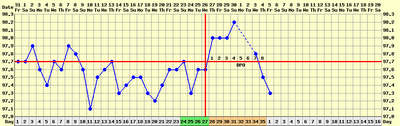
After you have charted your temperature for a month or s,o you will probably begin to see a pattern arise. What you will be looking for is a temperature increase of at least 0.4 degrees over a 48 hour period. This shift usually coincides with ovulation and marks the end of the follicular phase of your cycle.
Usually, the temperature will then drop and rise again during the luteal phase of that cycle (as shown in the sample chart). Most often the temperature will drop around the time of onset of menses. If your temperature remains high during the latter portion of your cycle for 18 days or more, you should test for pregnancy.
You may be able to see the shifts between cycle phases easily on your chart. However many women also draw a “coverline” on their chart to help them identify the cycle shifts. This is done by looking at the highest temps taken during the end of your period and looking for the first day your temperature rises at least 0.2 of a degree higher than the end of period high temps. The cover line is drawn one-tenth of a degree above the highest of the high days preceding the rise. (See sample chart).
Note that recording of additional symptoms such as cervical mucous and position add additional clues as to the status of your facility at any given time during your cycle. This article does not address those items but you may want to check the websites above for more information on this.
Problems that may arise and ways to troubleshoot
The birth control pill, coming off of the birth control pill, and recent miscarriage or childbirth may affect your chart and make it appear irregular or inconsistent.
Illness and/or fever may also skew your results. Unusual events such as travel, alcohol consumption, a restless night or extreme stress may also have an effect on your results. If you have a temperature on your chart which you think may be artificially high or low because of these circumstances or due to taking your temperature at a time outside of the norm for you, it is sometimes helpful to highlight or circle those temperatures on the chart so that you remember not to look as closely at them as you interpret your chart.
If you experience extremely erratic or unusual temperatures be sure to double check that you are taking your temperature at the same time each day and prior to any activity. You may want to note the time you took your temperature on your chart each day to help with this.
If you wake up an hour or two before you usually take your temperature and just have to go to the bathroom or something, it is better to take your temperature at that time rather than getting up, and then going back to bed until it is time to take your temperature. Getting up and going back to bed for an hour or two will interrupt you sleep/temperature pattern (remember – your temperature should be taken after at least five hours of uninterrupted sleep).
If you notice that you are not finding the ovulation spike in your temperatures or that your charts are not making sense to you, it may be helpful to take them to your OB/GYN and seek his or her input.
Personal Tips
Until you get used to taking your temperature regularly, it may be difficult to remember every morning. I place the thermometer right on top of my alarm clock when I go to bed so that I can’t even hit “snooze” without grabbing the thermometer.
A great resource for learning to chart your basal body temperature is the book Taking Charge of Your Fertility by Toni Weschler, MPH.
I have found that BBT charting is great for getting a handle on approximately when you ovulate each month but is more of a look backward. So basically, you don’t know you’ve ovulated until you’ve already charted it and passed it. I often use the charting in combination with ovulation predictor kits when trying to get pregnant.
If you are seeing an OB/GYN for help with a fertility issue you may want to take your charts to your next appointment. My OB was able to use my charts to help determine how to treat me.
By Cassandra
Why would you track your basal body temperature?
Your basal body temperature is your body temperature taken immediately upon waking. This temperature, when taken daily and plotted on a chart, can help identify the status of your fertility at various times throughout your monthly cycle. Women often use BBT tracking to assist them in becoming pregnant. It may also help determine inconsistencies in a woman’s cycle which may be affecting her ability to conceive. Finally, women also use BBT tracking to aid in their efforts to avoid pregnancy.
What you can expect
BBT Tracking is relatively simple and inexpensive. You will need a thermometer that shows temperature with at least one decimal, paper, and a pencil. Digital thermometers are often the most accurate and reliable but you may use a glass thermometer if you wish, so long as it is a “basal body” thermometer. Ear thermometers are not recommended as they are often not as reliable.
You may begin charting at any time in your cycle so long as you are sure to record the temperature on the correct cycle day area of the chart you are using. Cycle Day One is always the first day of your period.
Each morning upon waking, prior to any activity, take your temperature and note the result on a sheet of paper. It is preferable to take your temperature even before speaking as your temperature will be higher if you move around first. This will skew your charting results. In addition, you should try to take your temperature at approximately the same time each day and always after at least 5 hours of sleep (3 hours uninterrupted sleep minimum). Your temperature rises approximately .2 degrees per hour throughout the morning (or will be approximately .2 less for each hour earlier). This change in temperature (due to inconsistent timing) will skew your charting results.
When writing down your daily temperature, it is helpful if you also note any other symptoms you may have such as breast tenderness, headache, moodiness, consistency of cervical mucous, and cervical position. You can note anything that seems to be a part of your monthly cycle. Although technically not required to use BBT tracking, these additional notes will help you read your charts with more accuracy.
It is easiest to see the patterns in each cycle’s temperatures if you chart them on a graph. Most women use a chart something like the sample below. The following websites offer printable, downloadable or online charts:
http://www.fertilityfriend.com
http://www.pinelandpress.com/faq/bbt/bbtfaq.html
http://www.tcoyf.com
http://conception.parenthood.com/bbt_chart.html
There are many more websites out there that offer similar charts. You can find them by searching the web for “basal body temperature” or “basal body chart”.
Sample BBT Chart
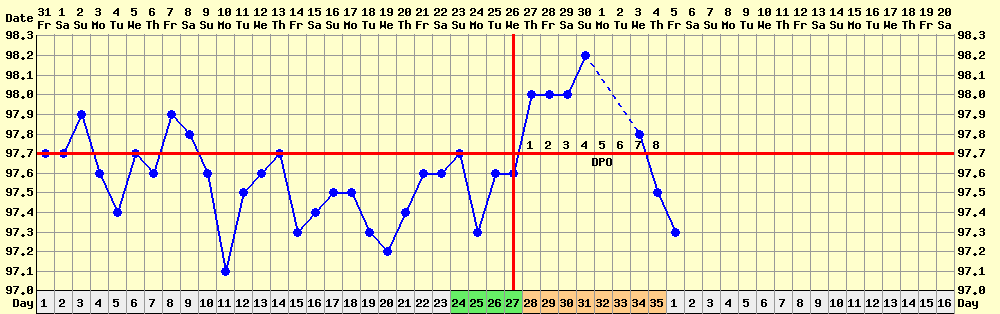
After you have charted your temperature for a month or s,o you will probably begin to see a pattern arise. What you will be looking for is a temperature increase of at least 0.4 degrees over a 48 hour period. This shift usually coincides with ovulation and marks the end of the follicular phase of your cycle.
Usually, the temperature will then drop and rise again during the luteal phase of that cycle (as shown in the sample chart). Most often the temperature will drop around the time of onset of menses. If your temperature remains high during the latter portion of your cycle for 18 days or more, you should test for pregnancy.
You may be able to see the shifts between cycle phases easily on your chart. However many women also draw a “coverline” on their chart to help them identify the cycle shifts. This is done by looking at the highest temps taken during the end of your period and looking for the first day your temperature rises at least 0.2 of a degree higher than the end of period high temps. The cover line is drawn one-tenth of a degree above the highest of the high days preceding the rise. (See sample chart).
Note that recording of additional symptoms such as cervical mucous and position add additional clues as to the status of your facility at any given time during your cycle. This article does not address those items but you may want to check the websites above for more information on this.
Problems that may arise and ways to troubleshoot
The birth control pill, coming off of the birth control pill, and recent miscarriage or childbirth may affect your chart and make it appear irregular or inconsistent.
Illness and/or fever may also skew your results. Unusual events such as travel, alcohol consumption, a restless night or extreme stress may also have an effect on your results. If you have a temperature on your chart which you think may be artificially high or low because of these circumstances or due to taking your temperature at a time outside of the norm for you, it is sometimes helpful to highlight or circle those temperatures on the chart so that you remember not to look as closely at them as you interpret your chart.
If you experience extremely erratic or unusual temperatures be sure to double check that you are taking your temperature at the same time each day and prior to any activity. You may want to note the time you took your temperature on your chart each day to help with this.
If you wake up an hour or two before you usually take your temperature and just have to go to the bathroom or something, it is better to take your temperature at that time rather than getting up, and then going back to bed until it is time to take your temperature. Getting up and going back to bed for an hour or two will interrupt you sleep/temperature pattern (remember – your temperature should be taken after at least five hours of uninterrupted sleep).
If you notice that you are not finding the ovulation spike in your temperatures or that your charts are not making sense to you, it may be helpful to take them to your OB/GYN and seek his or her input.
Personal Tips
Until you get used to taking your temperature regularly, it may be difficult to remember every morning. I place the thermometer right on top of my alarm clock when I go to bed so that I can’t even hit “snooze” without grabbing the thermometer.
A great resource for learning to chart your basal body temperature is the book Taking Charge of Your Fertility by Toni Weschler, MPH.
I have found that BBT charting is great for getting a handle on approximately when you ovulate each month but is more of a look backward. So basically, you don’t know you’ve ovulated until you’ve already charted it and passed it. I often use the charting in combination with ovulation predictor kits when trying to get pregnant.
If you are seeing an OB/GYN for help with a fertility issue you may want to take your charts to your next appointment. My OB was able to use my charts to help determine how to treat me.
Diagnosis: Male Factor
Diagnosis: Male Factor
by Bea
What Male Factor Infertility Means and Its Impact on Fertility
Male factor infertility (MFI) means, simply put, that a man has a lower than normal chance of fertilising an egg without assistance. "Lower than normal" may mean anything from slightly reduced to zero chance.
MFI is common. Statistics show 30-40% of infertile couples suffer exclusively from male factor infertility, 30-40% exclusively from female factor infertility, and the rest from unexplained or combination factors involving both partners. This serves to highlight the fact that infertility is far from being a female-only problem--in fact, the problem is equally likely to rest with the male. The reason behind a man's infertility is mostly elusive and unlikely to change the options for treatment.
Happily, MFI carries a generally good prognosis as long as some sperm are being produced. Amongst IVF patients, only those with tubal infertility are more likely to conceive. On the downside, if MFI is severe enough there is no hope of a "surprise pregnancy".
Sperm may lack the ability to fertilise an egg for one of a number of reasons:
- Count: Contrary to what you were told at school, it actually takes a minimum of between half and one million healthy, rapidly-motile sperm to fertilise a single egg. This equates roughly to a post-wash count of five to seven million sperm per ml. This is because sperm work together to navigate their way through the inhospitable environment of the female reproductive tract. It's physcially impossible for a single sperm to make a successful journey all by itself. So much for "it only takes one". Count may be reduced because of lack of production in the testicles, or failure of sperm to get from the testicles into the ejaculate (for example blockage/previous vasectomy).
- Motility: Only rapidly motile sperm can reach and penetrate an egg. Even if fertilisation happens in vitro, motility is required to get through the "shell" of the egg.
- Morphology: This is much less important than you might think, especially if you are using ICSI. The DNA contained in the head of abnormally-shaped sperm is just fine.
- Anti-sperm Antibodies: Antibodies can cause a loss of motility, the clumping together of sperm, and the inability for the sperm to fertilise an egg. This is much more common in men who have had vasectomies.
- Sperm DNA Fragility: This means the DNA carried in the head of the sperm is damaged. The somewhat controversial belief is that higher levels of DNA damage will lead to greater numbers of genetically abnormal embryos being formed, resulting in implantation failure and early pregnancy loss.
Diagnostic Process
Standard Semen Analysis: This will give an indication of count, motility and morphology. It will also give details of any other cells - for example white blood cells - which may indicate infection.
Post-wash Semen Analysis: Some specialists like to analyse the sample after washing, as if for an IUI. This will give a more accurate indication of whether the sample is good enough for IUI or whether IVF will be needed.
Antibody Tests: This is most reliably done on a semen sample. Tests include the immunobead assay and the mixed agglutination reaction. Results are given as a % of sperm with antibodies attached.
Sperm Chromatin Structure Assay: This is the test for DNA fragility. It's performed on a semen sample. Results are given as a DNA Fragmentation Index which aims to indicate what % of the DNA is damaged.
TESA/MESA/testicular biopsy: If no sperm at all are found in the ejaculate, an aspirate or biopsy may be taken to hunt for sperm in the epididymus or testicle. There's a big difference between a few sperm and no sperm at all.
Hormone assays: This is a blood test. FSH means much the same thing in men and women. High FSH indicates poor response by the testicles (or ovaries). Testosterone is usually also measured, and sometimes other hormones such as LH and prolactin.
Karyotyping: Some males have abnormal genes which affect fertility, such as the XXY karyotype which is known as Klinefelter's Syndrome, or the cystic fibrosis gene which can cause anatomical defects in the sperm transport system. Balanced translocations can also occur in males as well as females.
Physical examination and ultrasounds: You may be referred to a urologist for physical examination and ultrasound of the testicles and prostate. Two of the most common things to look for are varicocoeles and prostatic disease.
Treatment Options
Treatment of MFI is centred on IUI, IVF, and ICSI. IUI can be used to give a marginally poor ejaculate a "head start". IVF is used for more severe male inferility, and ICSI is used where the severity is such that sperm are no longer able to penetrate the egg by themselves at all. TESA/MESA or testicular biopsy are sometimes used to retrieve sperm, especially if none are present in the ejaculate. Some couples use donor sperm with IUI or IVF.
Many other options have been suggested. It's important to note that because it takes a while for sperm to be produced, any treatment which aims to improve semen quality will take three to six months to produce results.
Lifestyle factors such as overheated testicles (sauna/hot baths), smoking, or drug use can affect semen quality. These must be eliminated. In a few cases, this might be enough to resolve the problem.
Many dietary supplements, naturopathic remedies, and alternative therapies have been suggested over the years, including arginine, B vitamins, coenzyme Q10, SAMe, ginseng, vitamin C, zinc, L-carnitine, co-enzyme Q10, vitamin E and selenium, omega 3 fatty acid supplementation, and acupuncture. Sadly, studies fail to consistently support any benefit. However, when used as recommended there seems to be no harm, either.
Hormonal supplements are used by some specialists. Supplementing directly with testosterone seems to actually reduce male fertility, but clomid and FSH have been used to stimulate testicles into production. A limited number of studies show a marginal benefit, but not enough to replace the use of IVF/ICSI.
Sperm DNA fragility is treated using ICSI, which seems to produce a higher pregnancy rate than plain IVF in this group, and also TESA/MESA, the aim of which is to use the freshest sperm possible, based on the theory that most DNA damage happens whilst the sperm is being stored in the body. Men may also be advised to ejaculate frequently (ie daily) to reduce storage time.
IVF is the most successful treatment for antisperm antibodies, with ICSI used if fertilisation fails to occur. IUI is also an option in some cases.
Variocoelectomy remains controversial. Some studies show benefits and others show no benefit at all. Some specialists believe there are select groups of patients in which the surgery is worthwhile. Be sure to discuss the pros and cons fully with your doctor.
Vasectomy reversal is most successful in cases where modern techniques have been used, and where the vasectomy was fairly recent (less than a couple of years). A successful reversal produces sperm in the ejaculate but count, motility and antibodies may still warrant assisted conception. Discuss the pros, cons, costs and chances of success carefully with your doctor prior to surgery.
Infections, prostatic disease or other conditions should be treated as indicated. If there has been prolonged or severe insult to the testicles, assistance may still be needed to achieve pregnancy.
Personal Experience
It's pretty clear from our semen analysis that IVF/ICSI is the only way we're going to be able to achieve a pregnancy using our own gametes. Obviously this is not good news, but at least we have the chance to try. Our other options are sperm/embryo donation or adoption. No good reason has been found for our diagnosis, but the chicken pox Mr Bea contracted for the first time at sixteen years old is a possible culprit.
The biggest thing that strikes me about male factor infertility is the stigma. There are few men who are confident enough to talk about their diagnosis openly, and I find myself restricted from talking about our problems with friends and family at the express request of my husband, who wants his diagnosis to remain private. If I do tell someone we're doing IVF, it's automatically assumed we have a female factor problem.
Subscribe to:
Posts (Atom)